Indiana Pacers Worth Hundreds of Millions

pacers
Forbes magazine is stating that the Indiana Pacers has spiked in value over the last year and is now edging up to the “Billion Dollar” mark. Here is more in their report:

The value of the Indiana Pacers franchise skyrocketed by $355 million just since last year to $830 million, according to Forbes magazine. The Pacers rank 21st among the NBA’s 30 teams. The Los Angeles Lakers were first at $2.6 billion. In the magazine’s annual report on franchise values, posted Wednesday, reporter Kurt Badenhausen attributed the huge growth of the NBA to “a massive new $24 billion television contract, a nearly six-year bull market in equities creating tremendous wealth, and cheap credit.”

The Pacers new financial numbers are perplexing considering the deal they struck last year with the city of Indianapolis using taxpayer money to subsidize their operations.

The Pacers’ value also increased 74 percent and could renew questions about the Capital Improvement Board’s decision, less than a year ago, to use $160 million in tax money to cover operating costs and upgrades at Bankers Life Fieldhouse. The Pacers keep revenue from all fieldhouse events — basketball and non-basketball alike.

The CIB who negogiated the deal gets money from taxpayers:

The CIB gets its revenue primarily from hotel, food and beverage, and admissions taxes. The agency also collects money from rental fees, parking garage income, car rental taxes, cigarette taxes and Downtown income and sales taxes.

While most of the CIB’s revenue comes from Marion County, six neighboring counties — Boone, Hamilton, Hancock, Hendricks, Johnson and Shelby — also pitch in through a 1 percent food and beverage tax.

H/T Indianapolis Star

2015 Super Bowl TV Ad Costs

image

America is passionate about not only watching the end of the year contest between the top two NFL teams, but also the commercials. But how much does it cost the companies to get their ads placed during the game?

Yahoo Sports has the breakdown:

The Super Bowl ads, and presumably the Super Bowl as well, will be on NBC next year, and hoo boy, is the Peacock Network looking to cash in. Variety reports that NBC is asking $4.5 million for 30-second spots, obviously a record and a 12.5 percent increase over Fox’s rate just this past year.
Why on earth would anyone pay this much money for a single commercial? Because the Super Bowl is the most-watched television program of the year; Super Bowl XLVIII was the most-watched show in human history with 111.5 viewers.

Just ten years ago a Super Bowl ad spot ran for $2.4 Million

Community Colleges Produce Poor Results

image

In the President’s State of the Union tonight he will unleash another signature plan of throwing money at something. This one is “Free Education” at two year community colleges. That will be a terrible idea and Cato Institute explains why:

Take completion rates. According to the federal Digest of Education Statistics, only 19.5 percent of first-time, full-time students at two-year public schools finish their programs within 150 percent of the time they are slated to take. So less than 20 percent finish a two-year degree within three years, or, say, a 10-month certificate program within 15 months. And that rate has fallen even since 2000, when 23.6 percent of students completed.

That statistic doesn’t change much when you account for student transfers. According to the National Student Clearinghouse Research Center, only 20 percent of community college students transfer to four-year institutions. Four years later, 72 percent of those have completed their degree or remain enrolled. That inches the success rate to roughly 34 percent.

For profit two year programs come with a steeper cost, but more people flock to them then community colleges.

Given the wide price difference, you would expect for-profit schools to be getting their lunch eaten by already dirt-cheap community colleges. They haven’t been. Between 1990 and 2010, for-profit colleges saw much faster enrollment growth than community colleges; 179 percent compared to 44 percent. Why?

There are many reasons, but one seems to be that for-profits are more responsive to students’ needs and desires than community colleges. They appear to offer more flexible scheduling, better focused training and superior student services. They can charge more in part because they provide a better service.


Cato’s write up is in depth and also tackles “the fraud” issue as well. Take a look at the rest of it here.

Unused Gift Card Economy

During the holidays billions of dollars in gift cards are received. Amazingly these cards start slipping through the cracks to never be used. How much is still lingering around:

“People are letting cash slip away that they could be using,” says John Kiernan, a senior analyst with CardHub. Kiernan, citing CardHub numbers, estimates that some $44 billion in unredeemed gift-card value has been accumulating since 2008.

Unused gift cards aren’t just free money for retailers either:

For retailers, however, gift-card sales don’t count as revenue until cards are used, meaning that retailers are holding $44 billion in liabilities against these unused cards.

NYPost also provides more information on how consumers can cash in the cards as well.

Really fascinating piece of the economy that is bigger than what one thinks.

Inflation Alert: Food Prices

My niche in my blog posts is inflation tracking. I do it because of how I position my investments and watching the unethical approach by MSM in not tracking it. Inflation hurts a lot of people and sucks money out of the economy that can be used for savings or other purchases. This update of increases comes from the Wall Street Journal:

Food prices rose 0.3% in December and 3.4% from a year earlier, the largest 12-month increase since February 2012, the Labor Department said Friday.

You can read the rest here.

Realtors Dream: $100 Million Condo Sale

Per NY Daily News:

A palatial apartment on 57th St.’s so-called ‘Billionaires’ Row’ has broken the record for the most expensive apartment ever sold in Manhattan.

A buyer dropped a staggering $100.47 million on the apartment, which occupies the entire 89th and 90th floors of One57, the high-end apartment tower overlooking Central Park at 157 W. 57th St., according to city records.

The property is the first single-family home to sell for an excess of $100 million in the city’s history.

Inflation Alert: Girl Scout Cookies

girl scouts
Inflation is more often associated with the price of a product going up. But inflation is also measured by a product being produced in a smaller size but staying the same on price. Girl Scout cookies fall into both of those categories.

First, lets look at the price of buying Girl Scout cookies. The 2015 price per box according to the Girl Scout website is now $5. In 2009 the price of a box was $3.50 and faced the other side of inflation, downsizing the product. The website popsugar.com noted the downsize:

According to the organization, the cost of flour rose by 30 percent, assorted cooking oils by 40 percent, and cocoa by at least 20 percent. The company felt this was the best method of dealing with increasing raw material prices. Alternatively, Girl Scouts could have used cheaper ingredients, or raised cookie prices from their current price of $3.50 per box.

Second downsizing of the product happened in 2011 as noted by OCWEEKLY blogs:

The Girl Scouts announced earlier this week that both the size and quantity of some remaining flavors will also dwindle slightly–as of now, only the Lemon Chalet Cremes are reducing in size, while the downsized quantities include Thin Mints, Peanut Butter Sandwiches, Shortbread Cookies, DoSiDos and Trefoils (up to four fewer cookies per box).

The reasons behind these changes? A rise in both transportation and baking costs. As a result, the agreed-upon course of action was to “lower the net weight of our cookie boxes slightly rather than ask our customers to pay a higher per-package price during these difficult times,” Girl Scouts spokesperson Michelle Tompkins told CNN.

Girl Scout cookies are shrinking in product serving and have spiked in price by almost 45%.

Final TV Ratings for College Football Bowl Games

Sports Media Watch released the final TV ratings for college football. Click here to read their more complete breakdown. But here is a snapshot of the games and how many watched.
image

Food Stamps Usage Increasing

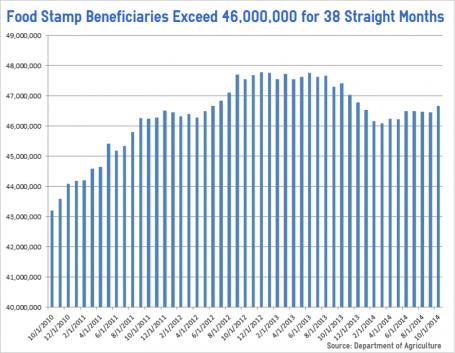
Food stamp usage is on the rise again in America. Rough estimate of what the federal government spends is around $77 Billion a year. What makes this news worthy is it conflicts with the notion that the economy is in great shape. Another problem is the program is very lax on rules and has become a new “social justice” program.

Here is more from CNSNews.com

The number of beneficiaries on the Supplemental Nutrition Assistance Program (SNAP)—AKA food stamps–has topped 46,000,000 for 38th straight months, according to data released by the Department of Agriculture (USDA).

In October 2014, the latest month reported, there were 46,674,364 Americans on food stamps. Food stamp recipients have exceeded 46 million since September 2011.

image

If you don’t believe this program isn’t somewhat over used, let this stat sink in:

In 1969, the average participation in the SNAP program stood at 2,878,000. In 2014, average participation grew to 46,536,000 showing an increase of 1516.96 percent.