An article posted in November 2014 at TaxFoundation.org, gives a detailed analysis
Continue reading →
Tag / Money
Indiana Ranked 16th on Fiscal Solvency
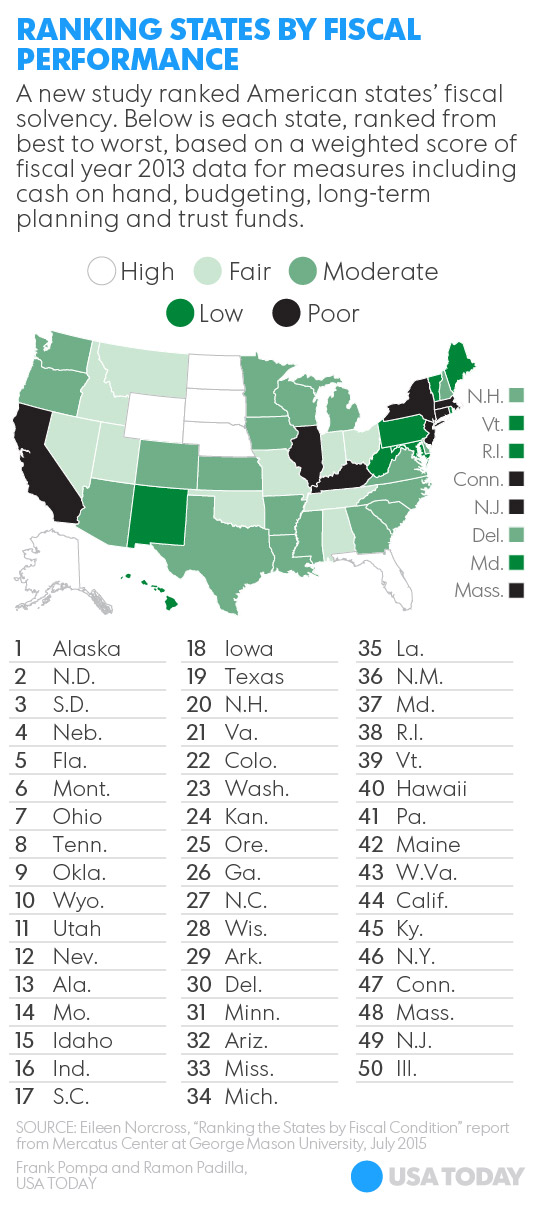
Via USA Today –
The Mercatus Center, a public policy research group, ranked the 50 states based on how well each state government planned spending in fiscal 2013 — the most recent year for which data was available — as well as their future financial prospects. from annual budgeting to cash to pay bills, to funding for pensions and long-term plans.
2015 Most Popular Fast Food Chains

Via CNN –
While satisfaction with the restaurant industry has waned, the survey found Americans Continue reading →
New Poll: If Given the Chance, Would You Opt of Social Security to Invest Your Own Money?
What Santa Claus Gets Paid

Tis the season for kids visiting Santa Claus at the mall or Santa being hired out for large Christmas parties. What is the pay for being ol’ St. Nick. Aol.com had one write up and found this:
First, the good news: The pay can be exceptional. A PayScale survey showed that Santas can earn up to $100 an hour. Amounts posted at RealSantas.com show even higher rates, $175 to $300 for the first hour for posing as Santa at private parties. Additional hours average $125 to $200 each.
Marketwatch found mall Santa’s get the shaft while others make the money:
Mall Santas have a far less lofty rate ranging between $10 and $40 per hour. Those offering private visits (no chimneys, please) might charge anywhere from $50 to $300 per hour. Typical Saint Nick earns more in six weeks than many consumers do in six months. A Santa might make $8,000 to $15,000 during the holiday season, and particularly talented ones can pull in as much as $80,000
Don’t just think Santa shows up without any effort either.
Many pay as much as $1,000 in tuition and other costs to receive specialized training at a professional Santa school. On the syllabus: Sign language, voice projection and storytelling, an immersion course in the six levels of child development and 30 different ways to work with a hesitant child.
Where Did the Term “Black Friday” Come From?
Economically speaking today is “The Day” for many retailers to take in massive amounts of revenue from eager holiday shoppers. “Black Friday” has been embedded into the American culture for many decades now. The term itself is hardly ever explored in its origin. I have found one historical explanation via The American Dialect Society:
[From *Public Relations News*, 18 December 1961, p. 2. This weekly
newsletter was published by Denny Griswold of 815 Park Avenue, New
York, NY.]Santa has brought Philadelphia stores a present in the form of “one of
the biggest shopping weekends in recent history.” At the same time,
it has again been proven that there is a direct relationship between
sales and public relations.For downtown merchants throughout the nation, the biggest shopping
days normally are the two following Thanksgiving Day. Resulting
traffic jams are an irksome problem to the police and, in
Philadelphia, it became customary for officers to refer to the
post-Thanksgiving days as Black Friday and Black Saturday. Hardly a
stimulus for good business, the problem was discussed by the merchants
with their Deputy City Representative, Abe S. Rosen, one of the
country’s most experienced municipal PR executives. He recommended
adoption of a positive approach which would convert Black Friday and
Black Saturday to Big Friday and Big Saturday. The media cooperated
in spreading the news of the beauty of Christmas-decorated downtown
Philadelphia, the popularity of a “family-day outing” to the
department stores during the Thanksgiving weekend, the increased
parking facilities, and the use of additional police officers for
guaranteeing a free flow of traffic … Rosen reports that business
over the weekend was so good that merchants are giving downtown
Philadelphia “a starry-eyed new look.”
Hoosier Lottery On Pace for Almost $1 Billion in Revenue

Hoosier Lottery officials are announcing that the organization is on pace for record breaking numbers in revenue. Per Indiana Economic Digest:
The Hoosier Lottery is on pace for a record revenue year, thanks in part to to higher Powerball ticket prices and jackpots. The lottery projects that revenue for its 2013 fiscal year ending June 30 will be $945 million, about 9.5 percent more than last year’s record of $855.6 million. The impact on Indiana coffers won’t be as impressive. Lottery officials are forecasting net income at $227.6 million, about $200,000 more than last year’s result.
There is one catch to the whole record breaking revenue celebration though…..
One reason the record sales won’t bring more income to the state for the fiscal year is that the lottery is spending about twice as much as it did last year on advertising and promotion—nearly $23 million. The commission forecasts total operating expenses will come in at $716.5 million, more than 10 percent higher than last year’s $645 million.
I still think a better investment than Powerball tickets is this. It just lacks the excitement.
 Hoosier Econ