Community Colleges Produce Poor Results

image

In the President’s State of the Union tonight he will unleash another signature plan of throwing money at something. This one is “Free Education” at two year community colleges. That will be a terrible idea and Cato Institute explains why:

Take completion rates. According to the federal Digest of Education Statistics, only 19.5 percent of first-time, full-time students at two-year public schools finish their programs within 150 percent of the time they are slated to take. So less than 20 percent finish a two-year degree within three years, or, say, a 10-month certificate program within 15 months. And that rate has fallen even since 2000, when 23.6 percent of students completed.

That statistic doesn’t change much when you account for student transfers. According to the National Student Clearinghouse Research Center, only 20 percent of community college students transfer to four-year institutions. Four years later, 72 percent of those have completed their degree or remain enrolled. That inches the success rate to roughly 34 percent.

For profit two year programs come with a steeper cost, but more people flock to them then community colleges.

Given the wide price difference, you would expect for-profit schools to be getting their lunch eaten by already dirt-cheap community colleges. They haven’t been. Between 1990 and 2010, for-profit colleges saw much faster enrollment growth than community colleges; 179 percent compared to 44 percent. Why?

There are many reasons, but one seems to be that for-profits are more responsive to students’ needs and desires than community colleges. They appear to offer more flexible scheduling, better focused training and superior student services. They can charge more in part because they provide a better service.


Cato’s write up is in depth and also tackles “the fraud” issue as well. Take a look at the rest of it here.

Inflation Alert: Food Prices

My niche in my blog posts is inflation tracking. I do it because of how I position my investments and watching the unethical approach by MSM in not tracking it. Inflation hurts a lot of people and sucks money out of the economy that can be used for savings or other purchases. This update of increases comes from the Wall Street Journal:

Food prices rose 0.3% in December and 3.4% from a year earlier, the largest 12-month increase since February 2012, the Labor Department said Friday.

You can read the rest here.

Realtors Dream: $100 Million Condo Sale

Per NY Daily News:

A palatial apartment on 57th St.’s so-called ‘Billionaires’ Row’ has broken the record for the most expensive apartment ever sold in Manhattan.

A buyer dropped a staggering $100.47 million on the apartment, which occupies the entire 89th and 90th floors of One57, the high-end apartment tower overlooking Central Park at 157 W. 57th St., according to city records.

The property is the first single-family home to sell for an excess of $100 million in the city’s history.

Inflation Alert: Girl Scout Cookies

girl scouts
Inflation is more often associated with the price of a product going up. But inflation is also measured by a product being produced in a smaller size but staying the same on price. Girl Scout cookies fall into both of those categories.

First, lets look at the price of buying Girl Scout cookies. The 2015 price per box according to the Girl Scout website is now $5. In 2009 the price of a box was $3.50 and faced the other side of inflation, downsizing the product. The website popsugar.com noted the downsize:

According to the organization, the cost of flour rose by 30 percent, assorted cooking oils by 40 percent, and cocoa by at least 20 percent. The company felt this was the best method of dealing with increasing raw material prices. Alternatively, Girl Scouts could have used cheaper ingredients, or raised cookie prices from their current price of $3.50 per box.

Second downsizing of the product happened in 2011 as noted by OCWEEKLY blogs:

The Girl Scouts announced earlier this week that both the size and quantity of some remaining flavors will also dwindle slightly–as of now, only the Lemon Chalet Cremes are reducing in size, while the downsized quantities include Thin Mints, Peanut Butter Sandwiches, Shortbread Cookies, DoSiDos and Trefoils (up to four fewer cookies per box).

The reasons behind these changes? A rise in both transportation and baking costs. As a result, the agreed-upon course of action was to “lower the net weight of our cookie boxes slightly rather than ask our customers to pay a higher per-package price during these difficult times,” Girl Scouts spokesperson Michelle Tompkins told CNN.

Girl Scout cookies are shrinking in product serving and have spiked in price by almost 45%.

Food Stamps Usage Increasing

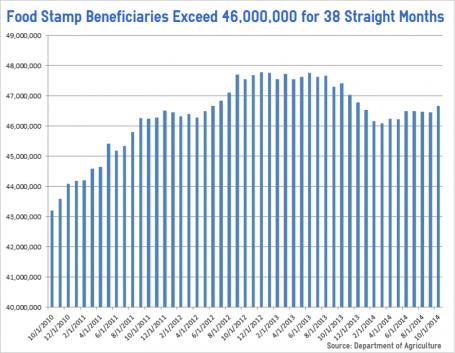
Food stamp usage is on the rise again in America. Rough estimate of what the federal government spends is around $77 Billion a year. What makes this news worthy is it conflicts with the notion that the economy is in great shape. Another problem is the program is very lax on rules and has become a new “social justice” program.

Here is more from CNSNews.com

The number of beneficiaries on the Supplemental Nutrition Assistance Program (SNAP)—AKA food stamps–has topped 46,000,000 for 38th straight months, according to data released by the Department of Agriculture (USDA).

In October 2014, the latest month reported, there were 46,674,364 Americans on food stamps. Food stamp recipients have exceeded 46 million since September 2011.

image

If you don’t believe this program isn’t somewhat over used, let this stat sink in:

In 1969, the average participation in the SNAP program stood at 2,878,000. In 2014, average participation grew to 46,536,000 showing an increase of 1516.96 percent.

Tax Season: Deductions, Credits & More

Tax filing season is underway so here is some basic information for deductions and tax credits. Read more at Forbes as they have a big list for all types of taxpayers.

Standard Deductions. The standard deduction rises to $6,200 for single taxpayers and married taxpayers filing separately. The standard deduction is $12,400 for married couples filing jointly and $9,100 for heads of household.

Earned Income Tax Credit (EITC). For 2014, the maximum EITC amount available is $3,304 for taxpayers filing jointly with one child; $5,460 for two children; $6,143 for three or more children and $496 for no children.

Child Tax Credit. For taxable years beginning in 2014, the value used to determine the amount of credit that may be refundable is $3,000 (the credit amount has not changed).

Kiddie Tax. For 2014, the threshold for the kiddie tax – meaning the amount a child can take home without paying any federal income tax – remains at $1,000.

Indiana Governor Pence Submits 2016 – 2017 Budget

Indiana Governor Mike Pence submitted his budget proposal to the House and Senate for approval. The two bodies will debate the bill and then vote on a final budget at a later date.

I went over to the PDF file the state put out on overall spending areas of the budget. The one big glaring issue is the amount of federal funding the state receives for whatever programs are tied with that. Many people will argue that it captures the money Hoosiers pay in federal taxes and brings it back in the state. In that case, the money shouldn’t leave peoples paychecks at and just have it working economically in the first place.

Here are some budget numbers I found in the proposal. The proposal is for fiscal years 2016/2017:

Both years will cost Hoosier’s around $62 Billion

Education will eat up about 33% of the budget with spending projected at $22.5 Billion

Welfare (Food Stamps, Welfare, Medicaid, etc.) is projected at $28 Billion. $19 Billion of that is sent to Indiana by the Federal government. Start grasping we spend more on welfare then education.

Public Safety spending for the budget cycle is $3 Billion. I know Indiana prisons got more money but expect that to go up throughout the years. Criminals now have to serve 75% of the sentences.

The Governor’s office projected federal funds contributing to the budget for a total of $24.9 Billion.

Inflation Alert: Beer Prices Spike

Back in July I wrote about beer going up on sale and regular prices. Now the complete increase has taken affect. I took this photo today at the same Meijer’s I always shop at:
image

Case of beer is now hitting almost $20 warm. For many months the sale price ran $16.50.

Janet Yellen has her foot on the printing presses from most recent money supply data and consumers are spending more. Watch for more price increases over the next few months.

Rise of the Pork

image

Hoosier Ag reporter Cayla McLeland is reporting pork will be on the rise in the near future for the consumer.

Purdue Extension Ag Economist, Dr. Chris Hurt, says expansion could reach seven percent higher by the end of this year.

“Breeding herd has grown by over 212,000 animals over the last year and that’s mostly in the center of the country. The western corn belt breeding herd increased by 105,000 head with Missouri rising by 55,000 animals. Iowa by 40,000 and Minnesota by 10,000 head. The second-largest growth region was down in the southern plains and they’re still recovering, of course, from the long-term drought. Both Texas and Oklahoma have added 20,000 animals to the breeding herd over the last year.”

Consumers faced higher prices a few years back due to farmers thinning herds from the drought and the the PED virus hitting hard last winter.

Read the rest of the article here.

Indiana City Pays Off Bills and Becomes Debt Free

One city in Indiana is announcing it has no debt. Mishawaka, IN is now claiming it has paid off all its loans and is completely debt free.

Mayor Dave Wood announced today that The City of Mishawaka is debt free! For the first time in over 100 years, Mishawaka begins 2015 with no general obligation bond debt after making final bond payments in late December. The City’s latest bonds, originally issued between 2005-2007 for $12.3 million to finance various projects such as the City’s radio communication system and major park improvements were paid off several years early.

Back in 2012, Mayor Wood announced one of the major initiatives of his administration was the ambitious goal of paying off debt early to becoming debt free as a means of helping to insulate the city against unforeseen circumstances such as economic downturns, emergencies, and state funding source changes. Mayor Wood stated: “The City’s debt free status is not only rare, but it’s an obvious indicator of our ongoing, strong commitment to fiscal responsibility. This was only possible based on our ability to work together as a team. Clearly, this wouldn’t have been possible without the work of our Department Heads and the Common Council.”

You can read the rest here.