What Santa Claus Gets Paid

image

Tis the season for kids visiting Santa Claus at the mall or Santa being hired out for large Christmas parties. What is the pay for being ol’ St. Nick. Aol.com had one write up and found this:

First, the good news: The pay can be exceptional. A PayScale survey showed that Santas can earn up to $100 an hour. Amounts posted at RealSantas.com show even higher rates, $175 to $300 for the first hour for posing as Santa at private parties. Additional hours average $125 to $200 each.

Marketwatch found mall Santa’s get the shaft while others make the money:

Mall Santas have a far less lofty rate ranging between $10 and $40 per hour. Those offering private visits (no chimneys, please) might charge anywhere from $50 to $300 per hour. Typical Saint Nick earns more in six weeks than many consumers do in six months. A Santa might make $8,000 to $15,000 during the holiday season, and particularly talented ones can pull in as much as $80,000

Don’t just think Santa shows up without any effort either.

Many pay as much as $1,000 in tuition and other costs to receive specialized training at a professional Santa school. On the syllabus: Sign language, voice projection and storytelling, an immersion course in the six levels of child development and 30 different ways to work with a hesitant child.

How Much Do Consumers Pay to Healthcare Providers?

Just Facts Daily posed a question to readers regarding healthcare payments. Here is the question and answer:

What portion of all healthcare spending in the U.S. is directly paid by consumers to healthcare providers (i.e., not indirectly paid through middlemen like insurance companies or governments)?

Less than 25%

In 2009, consumers directly paid for 12% of all healthcare spending in the U.S., as compared to 48% in 1960. This trend has been driven by government policies and is a major factor in the rise of healthcare spending, because it reduces consumers’ incentive to shop for the best value.

California Pension System Imploding

With Detroit bankruptcy being approved just a few weeks ago look for many other municipalities and possibly states to use similar methods to fend off economically impossible to meet financial demands.
The next bankruptcy is best captured in the LA Times article entitled “California pension funds are running dry” :

The state’s pension goliath, the California Public Employees’ Retirement System, had $281 billion to cover the benefits promised to 1.3 million workers and retirees in 2013. Yet it needed an additional $57 billion to meet future obligations.

The bill at the state teachers’ pension fund is even higher: It has an estimated shortfall of $70 billion.

Bankruptcy has already happened in some California towns.

Meanwhile, cash-strapped cities are facing escalating bills. Rising pension costs contributed to bankruptcies in Stockton, San Bernardino and Vallejo.

The man behind the transparency movement in California is state Controller John Chiang. He started a website tracking a towns finances for the public to see and it grew from there.

Farmers Buying Most of the Farmland for Sale in 2014

image

Stumbled upon some interesting data about buyers of farmland while researching farmland value. This comes from AgriNews:

One thing they have noticed, Aupperle said, is that more farmers are purchasing the land. During the first nine months of the year, 71 percent of the land was purchased by farmers or their families.

“Farming community has really stepped up, while outside investors seem to be waiting to see if a correction comes,” Aupperle said. “The farming community has a lot of money from remaining steady for two years and when investors come back, an upward trend should continue.

Purdue Economics Program Top Ranked

Via jconline.com

Add another top national ranking to the Krannert School of Management at Purdue University.
The masters in economics program at Krannert was ranked 13th in the United States by Financial Engineer magazine.
The rankings were based on Graduate Management Admission Test scores, starting salary and bonus, undergraduate GPA, acceptance rate, full-time graduates employed at graduation, and full-time graduates employed three months after graduation.

College Student Loan Debt Exploding

image

When talking about economic “bubbles” one that is hardly ever mentioned is student loan debt. CreditCards.com had this about the amount of debt:

Debt affects people of all ages, but an explosion of student debt is weighing down this generation of young adults like no other before. According to data from the Federal Reserve, U.S. student loan debt soared from $550 billion in 2007 to nearly $1 trillion by 2013.

An April 2014 Wells Fargo survey reported that 29 percent of millennials (people between 22 and 33 years old) are worried about paying off their student loans, and data from FICO show that the burden of student-loan debts is contributing to a downturn in the number of millennials carrying credit cards.

You can read the rest of the article here.

Obamacare & 7 Eleven

7 eleven

Via thehill.com

ObamaCare ads will now appear on 7-Eleven receipts at more than 7,000 stores nationwide as government health officials expand their outreach in the second year of healthcare sign-ups.

Information about ObamaCare sign-ups will appear on the bottom of receipts for anyone using a mobile payment company called PayNearMe, which allows bank-less customers to pay in stores like 7-Eleven and Family Dollar.

Health and Human Services (HHS) Secretary Sylvia Mathews Burwell announced the new partnership with the tech start-up PayNearMe on Thursday at a store in Washington, D.C.

“Putting these reminders at the bottom of PayNearMe receipts will help get health coverage information into the hands of traditionally hard-to-reach consumers,” HHS wrote in a statement.
The partnership will help HHS “reach financially underserved and other cash-preferring consumers,” the statement reads.

Federal Government Deficit for 2015 Fiscal Year

government
CNSNews.com is reporting the federal governments 2015 first two fiscal months of tax revenue collected and how much it spent.

The U.S. Treasury continued to rake in tax dollars at a record rate in November as the federal government closed out the first two months of fiscal 2015 with $404,155,000,000 in total receipts, according to the Monthly Treasury Statement released today.
Even with these record revenues, the Treasury ran a deficit of $178.531 billion deficit in October and November as it spent $582.686 billion.

What were the sources of revenue?

The biggest source for the record federal revenue during the two-month period was the individual income tax. It brought in $192,619,000,000 in October and November. The second biggest source was “Social Insurance and Retirement Receipts,” the taxes Americans pay for Social Security and Medicare. These brought in $146,263,000,000.

How the Wealthy Write Off Taxes

image

Whenever I see someone famous on TV talking about the need for higher taxes or claiming they enjoy paying taxes I always say, “Their accountant is laughing”.
Senator Tom Coburn issued a report showing exactly what I mean.

The tax code is so peppered with special giveaways that companies such as Facebook end up getting refunds, and high-profile athletes and artists use their tax-free foundations to give friends jobs while avoiding taxes — all leading to higher income tax rates for the rest of us, Sen. Tom Coburn charges in a new report being released Tuesday.

Here is a snapshot of what was found by his staff:

-Baseball owners are able to claim their players “depreciate” over time, the same way farms are able to claim their tractors depreciate
– Athletes and Hollywood stars who form tax-exempt organizations that they then use as tax shelters, throwing parties or paying employees’ salaries from the tax-exempt accounts while dedicating almost no money to charitable works.
-Kanye West’s foundation spent more than $1 million in 2009 and 2010 but “gave virtually nothing” to charity. Fellow performer Lady Gaga’s Born This Way Foundation raised $2.6 million but only gave away $5,000 in grants

You can read more via Washington Times

Is the Indiana 529 College Choice Plan Worth It?

For many months now I’ve been hearing and seeing commercials for a program geared towards parents that helps them save for college. The program is called the COLLEGE CHOICE 529 INVESTMENT PLAN. Per Indiana Department of Education website:

The program allows Hoosiers to plan for their children’s or loved one’s future, making contributions into an investment account for higher education expenses. Indiana also enacted a tax credit that makes the CollegeChoice Plan an even better option.

You are directed out of the state website and to a place called College Choice Advisor. To be very brief, this is the site where you sign up an account and it gives you investment options for saving /giving. That is the key component of why I think a program like this is unnecessary…..investing. Parents can easily do this on their own with more options. This website really doesn’t offer a variety like you could get with a local advisor or you’re own research.
The investing assumptions they provide are very broad and unrealistic in today’s income reality a lot of people are living in. Per the website:

If an investor opened a 529 account with an initial investment of $2,500 and contributed $100 every month for 18 years, there could be over $6,300 more for a qualified withdrawal than the same investment in a taxable account.*

There is a reason for an asterisk at the end of that statement:

Assumptions: $2,500 initial investment with subsequent monthly investments of $100 for a period of 18 years; annual rate of return on investment of 5% and no funds withdrawn during the time period specified; and taxpayer is in the 30% federal income tax bracket for all options at the time of contributions and distribution. This hypothetical is for illustrative purposes only.

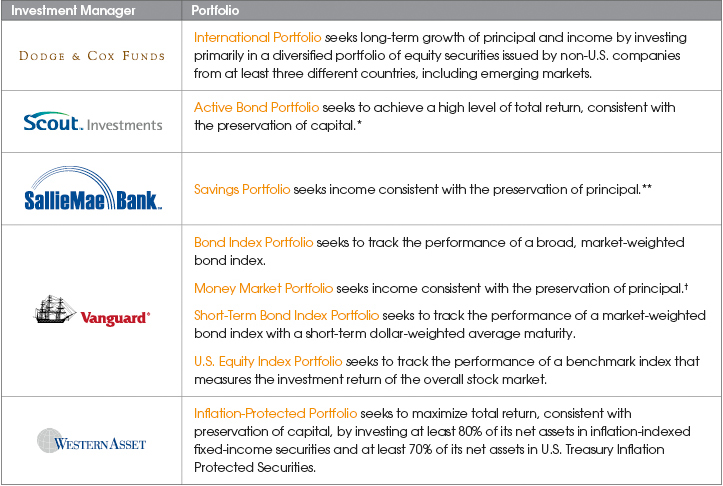
That is a big assumption. Going back to a recent comment is my philosophy of having many ranges of investment choices. The 529 doesn’t really offer much:
image

Overall the 529 is a plan that allows people to throw their money in a fund and than forget about it. I think parents should be more hands on with their money they save which then leads to conversations about money responsibility.

The majority of parents will never to be able to fully fund their children’s college and their’s nothing wrong with that. Big percentage of children will not attend or finish college at all. No one knows what college will be like 20 years down the road in a traditional sense. Save wisely for helping your child in college or with something else they may strive for. Just don’t hand it over to investors to draw a 1% fee for 18 years because it sounds good.