2014 Corn Harvest Depends on Next Sixty Days

While many midwest Americans have embraced the record breaking cool summer(Indiana coolest July since 1895) along with heavy rains, a lot of corn farmers are nervously awaiting the next sixty days in the pollination process of their corn harvest.

Early this month I blogged about Soybean/Corn numbers but more specifically this point

Heavy rains in the cornbelt in June(beginning of pollination) have mostly meant lower yields come harvest.

I even e-mailed an investor July 12th on the East Coast this point on the corn yields with all the rain and cool weather the area has received:

One corn follower said the very wet condition in the cornbelt occuring right when pollination takes off in June has always tilted towards lower yields in the last fifty years.

Now a few weeks later, Indiana Economic Digest published a story of farmers showing the wear of cool/wet weather affecting their corn crops. You can read the story here for full details but will quote some of it for quick reference.

Purdue University corn specialist Bob Nielsen said the cooler temperatures that delayed planting and have continued into the July growing season
“We just had way too much moisture here,” Sutton said. The result is variable heights in corn and depleted nitrogen. “The nitrogen deficiency causes the brown bottoms. … And, with less heat, the corn thinks it’s July 4th.” Sutton said a St. Louis, Missouri-based agronomist his family retained told them, “We have the worst crops in the nation.”

Lower yields than expected will ultimately drive up the price of corn. The pollination process of corn is a wait and see game. Last year ten days made the difference on record number corn/soybean harvest that developed in August. This year may prove a little later.

U.S. Military Veteran Tells of How Bad Communism Is

The other day I was engaged in some conversation with a man about the social affects of what Communism brought to countries. We started discussing the old Soviet Union. In short, Soviet Union historically engaged in disinformation. One example was the government told Russian’s that America would stage “traffic jams” or “large gatherings” if saw the events on tv. He decided to share this story with me of what he experienced in dealing with people from the old Soviet Union. I am paraphrasing the story.

I was stationed in North Carolina in 1975. The U.S. decided to bring over some Russian troops to train with us for a short time. One weekend we had some down time so my Colonel decided we should take the Russian guys out to party. We took them to a dance hall and partied for a little bit. The Russians came up to us and stated we had staged the scene and it was all propaganda. My Colonel took the guys outside to his car, reached into his glove box and slammed a map of North Carolina on his car hood. He demanded that the Russians point to any city on the map and he will take them there and show that many other bars exist with people gathering. The Russians chose a city hundreds of miles away. So we started that way and stopping at several bars along the way. The Russians were completely blown away in what they saw and they also got pretty drunk.

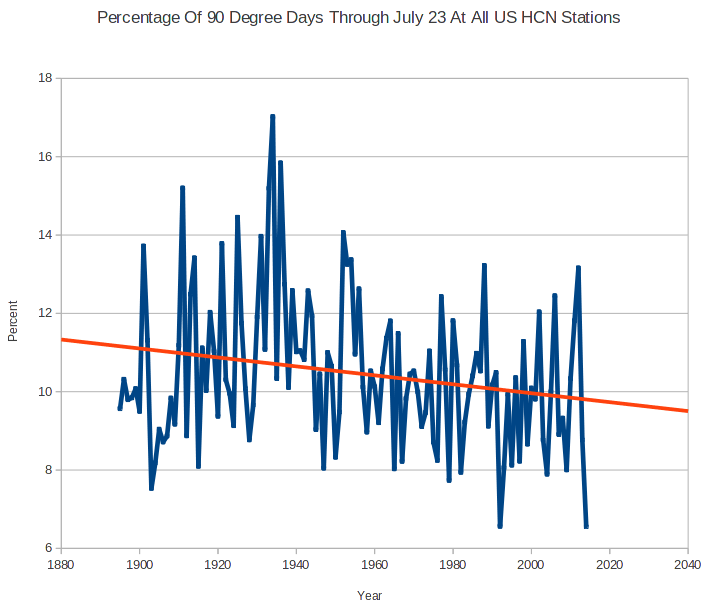
Coolest Summer On Record In The US

Good graph….

Tony Heller's avatarReal Climate Science

The frequency of 90 degree days in the US has been plummeting for 80 years, and 2014 has had the lowest frequency of 90 degree days through July 23 on record. The only other year which came close was 1992, and that was due to dust in the atmosphere from Mt Pinatubo.

ScreenHunter_1349 Jul. 26 16.57

View original post

Indiana’s Neighbor Illinois Needs To Mow Their Lawn

Standard & Poor’s Ratings Services again has threatened the state of Illinois to get their financial mess in order or else it will downgrade their bond ratings. Once you are downgraded, your borrowing rates go up making it more expensive to borrow. That means more of their yearly budget will be diverted to paying off interest and debt.

The credit rating agency affirmed the state’s worst-in-the-nation A- bond rating, but its outlook, which had been raised to “developing” earlier this year after enactment of pension reforms, went back to negative.
That means that the state’s credit rating could be downgraded within the next two years unless its finances improve, S&P said. A lower credit rating translates into higher borrowing costs.

Illinois biggest issue is their health pension system which is not sound financially. The Illinois Supreme Court recently had this to say:

“The Illinois Supreme Court was clear in its opinion that the health insurance subsidies paid by the state for retiree health care are a benefit derived from membership in a state pension plan and therefore subject to the Illinois Constitution,” S&P said.

S&P has stated that if the state comes to together for serious reform, then it would most likely revisit upgrading their status. Illinois has a big backlog of bills that already need paid and their most recent budget enacted will produce more deficits. They have used many gimmicks to reassure vendors/creditors in collecting tax revenue while doing bad borrowing schemes in the form of borrowing against future sales tax revenue.

I do not see Illinois changing its bad habits anytime soon.

What is the American Red Cross Hiding?

Charity is wonderful feature of economics and free societies. For years the American Red Cross was seen as an American staple of society relating to charity. Unfortunately for several years now it has turned into a very secretive and untrustworthy organization when it comes to money.

Red Cross started to be questioned around the time frame of the 9/11 terrorist attacks. Just that one event, they raised over $530 Million dollars and put $200 Million of that into “administrative & long-term” functions. Multiple media sources started catching onto the story and they finally started paying out to the victims.

Sharyl Attkisson in her new blog post has raised more questions of what the American Red Cross is doing with Hurricane Sandy funds. The following excerpts were taken through her blog from propublica.org:

Just how badly does the American Red Cross want to keep secret how it raised and spent over $300 million after Hurricane Sandy? The charity has hired a fancy law firm to fight a public request we filed with New York state, arguing that information about its Sandy activities is a “trade secret.” The Red Cross’ “trade secret” argument has persuaded the state to redact some material, though it’s not clear yet how much since the documents haven’t yet been released.

And the main reason why the American Red Cross is claiming “Trade Secrets”….

If those details were disclosed, “the American Red Cross would suffer competitive harm because its competitors would be able to mimic the American Red Cross’s business model for an increased competitive advantage,”

I really cannot say what “trade secret” Red Cross would try to be protecting. Yes, organizations like this can protect logos and other identifying marks but people donating to charity is not a trade secret that has to be kept under wraps. Americans can now just sit on their couch and donate from their cell phones and computer devices if they so choose. The charitable donations were also on top of the $60 Billion the government gave to the hurricane stricken area. That money itself will also have to be probably be investigated.

Sharyl Attkisson herself investigated five major non for profits who received charitable contributions to help the Hati people after their major earthquake. This is what she found:

On May 12, 2010 I reported for CBS News on how 5 major nonprofits, including American Red Cross, had spent funds intended for Haiti earthquake victims four months after the disaster. I noted that enough aid had been raised to give each displaced family a check for $37,000 but thousands of Haitians were still going hungry and living under flimsy shelters. I learned that, to a large degree, the charities can’t tell anyone with specificity where exactly all the money goes. They can give general figures such as, ‘we’ve given out 10,000 meals’ or ‘we’ve distributed 10,000 bottles of water,’ but I wondered why there wasn’t a spreadsheet that explains how many bottles or meals were shipped to which refugee camp and when. It seems pretty basic. After all, somebody has to know. A lot of the funds that donors intended for “emergency relief” were, in fact, still sitting in funds unspent. Some charity officials privately acknowledged that many charities receiving a giant influx of donations in the wake of a giant disaster are ill-equipped to produce long term recovery programs. They sometimes find themselves frantically trying to figure out how to spend all the money in a responsible way that serves the mission.

Myself, this is why I have been strictly going with local charities of affected areas or if a national charity, one that does not hesitate to provide data on their sites.

Illegal Immigrant Children: How Many Will End Up Staying In the U.S.?

The border crisis of minors is not a political issue that will soon go away. Many questions remain open ended about the processing of illegal immigrants from other countries that don’t fall under the title “empathy”. One question that is answered but no one in government leadership positions will truthfully state in the media is how long these children from other countries will be staying.

According to Congressional testimony given this week by Tom Homan, the Executive Associate Director for Enforcement and Removal Operations with ICE, 87% of these individuals are still in the U.S. This answer was in response to how many unaccompanied minors who were apprehended illegally entering the U.S. over the past five years are still in the U.S.

Indiana “Obamacare” Prices To Rise by Double Digits

Prescription drugs, new federal rules and insurer fees will help drive up healthcare premium costs related to Obamacare “Silver Plans” in Indiana by 16%. Bloomberg Business fills a rather short article with lots of good financial nuggets for readers to absorb. Bloomberg broke down the pricing.

How insurers set prices: Cost of claims, benefit changes, rising prices, risk pools, provider networks, geography, reinsurance, taxes and fees, profit and risk load.

With all that calculated, this is what they got for various states:

Image


Indianapolis Star: Gas stations bring crime and unhealthy food

Sunday addition of Indy Star brought about some reveleations that even stunned me. Not so much of its trueness but of its complete idiocy of accusations. According to Indy Star writer Erika Smith, Gas stations bring crime. The plot of the article is some neighbors in the area on the West side are not liking the growing number of gas stations popping up.

For the past five years, these businesses have been moving into this urban core neighborhood and others at an alarming rate: 10 stations within a two-mile radius along the high-traffic corridors of West Washington, West Michigan and West 10th streets

So what are the main reasons to not like gas stations now?

The problem isn’t so much with the gas that the stations sell, but with the crime they attract and the convenience stores that come with them. Full of cheap, unhealthy food and paraphernalia that people use for illegal drugs, the businesses are easy money makers in neighborhoods bereft of grocery stores and wracked by poverty.

She goes on to state as an example Rural/New York Street where there is a gas station. It had 900 calls over 10 years Smith states. I looked at that area for the month of May/June. Closest crime listed there through Spot Crime is three blocks east and IMPD labeled that as “Other”. Smith also goes on to state that those gas stations builders are following those pesky zoning laws:

The hangup is a mix of outdated zoning laws, neighborhoods that for years have been empty of vocal stakeholders, and the profitable business model of opening gas stations and convenience stores in poor urban areas.

Read the rest of the article if you want to see Academy award winning emotions for “Social Justice”. My job on this blog is to use Austrian thinking to rip apart crap published like this. Overall Smith’s biggest problem is the profit side of these gas stations. I can’t explain why she doesn’t like them, she just doesn’t. She will go to great lengths to demonize them to her audience. What Erika Smith doesn’t address from an economic standpoint is the amount of investment from investors or banks that go into building, remodeling or stocking a gas station. It takes great preparation of studying the area to see what needs are to be met. If it’s a poor area, countless economic writers have written about grocery stores leaving those areas because it’s 1) Too Risky & 2) Not profitable. What Erika Smith needs to do is kiss the feet of gas stations that open up in poor areas. Because without them, those in the X number of square block area wouldn’t have access to supplies the gas station has in stock.

I really don’t debate the “unhealthy food” scapegoat anymore. In this day and age, if you haven’t picked up the difference of bad or good food, then there isn’t much hope for you. Smith has stated in other articles throughout the years that some sort of organization through government needs to teach people on how to cook. She basically went full communist mode at that point.  

1952 Presidential Executive Action

Currently I am reading the book, Obama’s Enforcer: Eric Holder’s Justice Department. Pretty good so far but stumbled upon some historical context of regulation and thoughts from Supreme Court Justice Robert Jackson.

The president’s authority to issue executive orders is strongest when he does so with the backing of Congress (category one), more dubious when he issues an order pertaining to a topic on which Congress has not passed a law (category two), and weakest when the executive order is “incompatible with congressional command” (category three).

President Obama recently said he is about to go “on his own” and Congressman Boehner is threatening litigation. Many in media defending Obama by saying Congress won’t work with him. Maybe reading the above should give you pause in wondering why they won’t and if the President needs to take a breather.