Via @USGovtInterest Twitter page:
Month of December Interest on Debt payment $86,460,237,565.98
Fiscal YTD payments $118,589,429,039.05
Via @USGovtInterest Twitter page:
Month of December Interest on Debt payment $86,460,237,565.98
Fiscal YTD payments $118,589,429,039.05
Via CBCNEWS –
According to BBC News, a man from Norfolk, England recently paid £300 (about $540 Cdn) to have his sick goldfish treated a local veterinarian’s office.
Vet Faye Bethell of Toll Barn Veterinary Centre in North Walsham, England, examined the fish when it was brought it in and determined that constipation was the problem.
After consulting with the pet’s owner to be sure he wanted to shell out for the procedure, Bethell performed an hour-long surgery on the fish to remove “a lump blocking its bottom” with the help of two veterinary nurses.
The Indianapolis Star newspaper is struggling with circulation. The numbers I found were up to date as best I could research. Newspapers overall are struggling and losing revenue. I blogged about this before here from the revenue side. I also wrote about the insanity in rationale their writers use in correlating things.
My first stop in finding circulation numbers for the Star was its owners financial report for 2013. Gannett owns the paper. Here is what they reported for the Star’s circulation:
Average 2013 Circulation – Print and Digital Replica and Non-Replica
Morning
145,930Sunday
280,428
Now compare this number with two other sources with the first one being from 2005:

My second source comes from Wikipedia in 2008.
Wikipedia had a 2008 source that listed the Star’s circulation standing at 335,303 Daily and 366,349 Sunday. The only problem with this source cited, the link is now defunct.
Even with these numbers being all over the place from 2005 and 2008, it is still safe to draw a firm conclusion from the company’s own CPA certified financial report the Star’s circulation has dwindled substantially.

Crime against retailers is a high cost that gets absorbed either through higher prices for the consumer or loss of profit for the retailer. Not much is talked about this cost and some recent numbers shed some light on the issue. The National Retail Federation did a study in the spring of 2014 and here is what they found:
A decade has passed since NRF first surveyed its community of loss prevention and security executives about the impact organized retail crime has on their company, and with the release of the 2014 survey, it’s evident that the $30 billion a year problem still threatens retailers of all sizes throughout the country. According to the National Retail Federation’s 10th annual Organized Retail Crime Survey, which polled 76 senior retail loss prevention executives, eight in 10 (88.2%) retailers report that they have been a victim of ORC in the past year, down slightly from 93.5 percent last year.
New data also rolled in on states that helped retailers prosecute criminals:
According to the survey, three in 10 (30.6%) of those polled said they have noticed a reduction in ORC activity in states where laws are present. Additionally, of those retailers who have a presence in states with existing ORC laws, more than half (52.1%) noticed a positive impact on their ability to prosecute ORC offenders more effectively; nine in 10 (88.5%) said they have noticed an increase in support from law enforcement agencies when actively investigating organized retail crime cases. Specifically, 51.9 percent said they’ve noticed an increase in support from local/county law enforcement, 26.9 percent said state law enforcement and 9.6 percent said federal law enforcement. In states without ORC laws and where retailers have a presence, six in 10 (63.5%) say they haven’t noticed any changes in support from law enforcement.
You can read the rest of the report here.

TV ratings are in for the first year playoff system games and there were a lot of people who tuned in. Here are the latest numbers from TVline.com:
At 5 pm, the match-up between Oregon and Florida State — despite being the most lopsided Rose Bowl contest since 1948, with a final score of 59-20 — drew 28.16 million total viewers, up 51 percent from last year.
Then at 9 pm, O-H-I-O State’s 42-35 victory over Alabama drew 28.27 million viewers, surging 150 percent from last year’s Sugar Bowl.
This is good news for ESPN who is reportedly paying $470 million annually to host the semifinal games of the College Football Playoffs.

With President Obama having a disastrous 4 years of losing Democrats in the House and Senate, he will now have to face his opponents in the federal budget ring. The media and his supporters have given him a pass on not getting a budget implemented in the last six years. This year will be different with the House/Senate being revamped with budget conscious members.
Rebecca Shabad at TheHill.com has an excellent timeline of what the President faces in the next coming months regarding the 2016 budget. I suggest taking a look at the article for the detailed write up after each date listed.
February 2: Obama’s budget deadline
February 27: DHS funding runs out
March 15: Debt limit suspension expires
April 1: GOP budget resolution?
September 30: Shutdown deadline
October 1: Fiscal 2016 begins

According to the Wine Institute, Americans will consume Continue reading →
Government wants you to invest in them. President Obama talked of a new investment fund in the past and now, without consent of Congress, has started it up through the Treasury Department. Here is more from the Wall Street Journal:
A form of Roth Individual Retirement Account that allows people to save after-tax dollars and watch them grow tax-free until retirement, the new myRA offers a single investment option. It’s a private version of the G Fund that is available to federal workers and has lately been delivering annual returns of about 2% on its portfolio of Treasury securities.
Government is guaranteeing no fees to the investor. That is political code for the taxpayer will subsidize it.
Treasury is funding the program out of the budget for its Bureau of the Fiscal Service. The assertion here is that existing law allows this part of the Treasury to hire financial agents as part of its mission to efficiently finance the federal government.
Taxpayers are covering the costs, though their elected representatives in Congress never voted to create the program. So far Treasury also hasn’t told us the fees it is paying Comerica.

The NFL playoffs are about to begin and what people do not know is how players are paid for their appearance in these games. Players contracts are set up to pay throughout the season for the sixteen games they play. If they make the playoffs then they are paid the same as every other player on the team.
Here is a breakdown of the last years 2014 Playoffs/Super Bowl payouts. I would expect these numbers to increase for this years by a small amount:
• Wild-card game (division winners): $23,000
• Wild-card game (non-division winners): $21,000
• Divisional playoff game: $23,000
• Conference championship game: $42,000
• Super Bowl winners: $92,000
• Super Bowl losers: $46,000
A player on a division winner that plays in a wild-card game and goes on to win the Super Bowl would receive $180,000 (or $45,000 per game), the largest possible share.
H\T Kevin Manahan
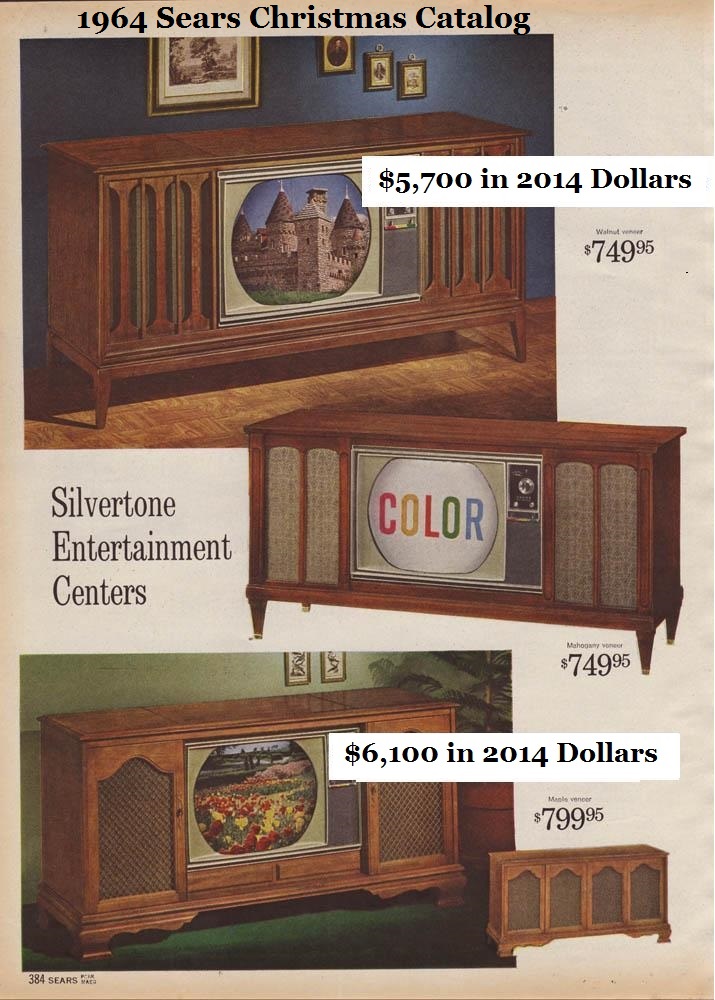
Economist Mark J. Perry at the American Enterprise Institute provided a piece showing the technology marketplace and how competition helps not only bring more products to the marketplace but also cheaper pricing.
Pictured above are some color TVs from the 627-page 1964 Sears Christmas Catalog, available here at the WishbookWeb website along with many other Christmas catalogs from 1933 to 1988. The original prices are listed ($750 for the Sears Silvertone entertainment center and $800 for the more expensive one), and those prices are also shown converted to today’s 2014 dollars using the BLS Inflation Calculator: $5,700 for the basic 21-inch color TV model and $6,100 for the more expensive model.
Click on this link to see what he found you can buy with the amount of money in todays dollars from the televisions listed above.
He also leaves on this final note and one reason why the U.S. is still one of the greatest economic innovators the world has ever seen.
As much as we might complain about a slow economic recovery, the decline of the middle class, stagnant median household income, rising income inequality and a dysfunctional Congress, we have a lot to be thankful for, and we’ve made a lot of economic progress in the last 50 years as the example above illustrates, thanks to the “magic and miracle of the marketplace.”
 Hoosier Econ