Where Did the Term “Black Friday” Come From?

Economically speaking today is “The Day” for many retailers to take in massive amounts of revenue from eager holiday shoppers. “Black Friday” has been embedded into the American culture for many decades now. The term itself is hardly ever explored in its origin. I have found one historical explanation via The American Dialect Society:

[From *Public Relations News*, 18 December 1961, p. 2. This weekly
newsletter was published by Denny Griswold of 815 Park Avenue, New
York, NY.]

Santa has brought Philadelphia stores a present in the form of “one of
the biggest shopping weekends in recent history.” At the same time,
it has again been proven that there is a direct relationship between
sales and public relations.

For downtown merchants throughout the nation, the biggest shopping
days normally are the two following Thanksgiving Day. Resulting
traffic jams are an irksome problem to the police and, in
Philadelphia, it became customary for officers to refer to the
post-Thanksgiving days as Black Friday and Black Saturday. Hardly a
stimulus for good business, the problem was discussed by the merchants
with their Deputy City Representative, Abe S. Rosen, one of the
country’s most experienced municipal PR executives. He recommended
adoption of a positive approach which would convert Black Friday and
Black Saturday to Big Friday and Big Saturday. The media cooperated
in spreading the news of the beauty of Christmas-decorated downtown
Philadelphia, the popularity of a “family-day outing” to the
department stores during the Thanksgiving weekend, the increased
parking facilities, and the use of additional police officers for
guaranteeing a free flow of traffic … Rosen reports that business
over the weekend was so good that merchants are giving downtown
Philadelphia “a starry-eyed new look.”

MLB Player Change Teams Because of Taxes?

image

Pablo Sandoval few days ago signed with the Boston Red Sox in a free agent deal for five years and worth $100 Million. Kurt Badenhausen of Forbes wrote why Pablo left San Francisco:

Massachusetts has a flat personal income tax rate of 5.2%. California uses a progressive rate topping out at 13.3% at and above $1 million of income. In other words, 95% of Sandoval’s income would be taxed at this 13.3% rate if he re-signed with the Giants.

The Giants play in the National League West, which boasts three teams from California, including the Giants. This means that in addition to the Giants’ 81 home games, the team plays another 18 road games in California. The Giants also play three road games against their cross-bay rival A’s, bringing their total California games to 103.While Boston has to play ten games next year at the New York Yankees, it also has division opponents in Florida and Canada, where the players will pay no state income taxes (and no federal taxes in Canada).

Baseball players living in no-tax states have about 18.4% of their 2015 salaries sheltered from state taxes due to Spring Training taking place in tax-free states (Arizona does not tax Spring Training days). The Red Sox enjoy an additional 14.3% of tax-sheltered income from road games, while the Giants only get to shelter another 5.8%.

Read the rest here

Dutch Central Bank to US: Pound Sand

The United States Federal Reserve is not trusted and it doesn’t appear to be getting any better. In plain speak, the Dutch just told them they didn’t either. Also take this news as a great investment tip to start buying gold and silver as a precautionary investment.

The Dutch central bank, De Nederlandsche Bank, has repatriated in utmost secrecy 122.5 tonnes of gold from the Federal Reserve Bank of New York to its vaults in Amsterdam, The Netherlands, according to a press release from DNB published today.

“It is no longer wise to keep half of our gold in one part of the world,” a DNB spokesman said. WOW.

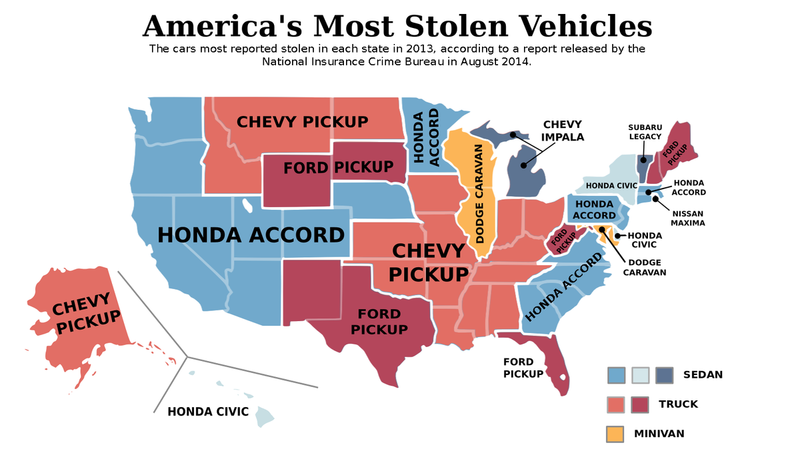
America’s Most Stolen Vehicles by Region

image

Why Doctors Are Leaving Medicaid

The new healthcare law that passed in 2010 was more of an expansion of getting people on medicaid then getting insurance. Medicaid is the “universal health care” that most don’t realize exists and it is taking on millions of new people each year. FORBES magazine has pretty lengthy write up about this program along with medicare.

Doctors seeing Medicare patients face a 24 percent cut in reimbursements beginning January 1.  But almost no one has grasped that those cuts will hit Medicaid too—thanks to Obamacare. Together both programs cover more than 100 million Americans, and the government expects about 9 million more people to join Medicaid next year.

The number of just regular doctors is drying up as new doctors coming out of med school go into specialty areas. Doctors cannot afford new Medicaid patients and here is one reason why:

Medicaid pays doctors about 59 percent of what medicare pays them—which is why doctors increasingly refuse to take new Medicaid patients.

In 2012 doctors ran to the exits in fleeing medicaid.

The Centers for Medicare and Medicaid Services (CMS) recently released a document showing that 9,500 doctors who had previously accepted Medicaid patients refused to do so in 2012.

In 2013 Congress voted to increase medicaid payments at the same rate of medicare. Now that is about to get cut again. The up and down of government intrusion in healthcare as this complicated law unfolds is taking a toll on our healthcare system. The people who suffer ultimately will be the patients.

Countries That Sold Military Weapons To Saddam Hussein

image

The Stockholm International Peace Research Institute investigated what countries sold Iraq weapons while Saddam Hussein was dictator. Their research debunks the long held belief that the United States was the sole seller of military arms.

Share per nation of sale of weapons to Iraq from 1973 through 2002.

USSR/Russia 57%
France 13%
China 12%
Czech 7%
Poland 4%
Brazil 2%

America is tied with Egypt, Romania, Denmark and Libya at 1%.

2012 Female Dominated Doctor Degrees

image

Photo via @Mark_J_Perry

2014 Corn & Soybean Yields Explode

corn harvest
Harvest season is wrapping up across the nation. Here is some Indiana and national stats gathered up from various sources around the internet:

Corn for grain production will set a new record in 2014 at 14.5 billion bushels on fewer acres planted compared to 2013. World corn production is also setting new records.

Soybean farmers are now expected to harvest 3.96 billion bushels, up 31 million bushels from the October estimate. Fifteen states including Indiana, Missouri and South Dakota are expected to report records for the amount of soybeans grown per acre with the average yield at 47.5 bushels per acre. Area for harvest in the United States is forecast at a record 83.4 million acres, unchanged from last month.

(Indiana) Corn yield was unchanged from last month’s projection of 186 bushels per acre. This will be a record corn yield for Indiana if realized. Corn for grain harvested acres was 5.75 million acres. Total production is still expected to weigh in at a record-breaking 1.07 billion bushels. Soybean yield at 54.0 bushels per acre was unchanged from last month’s forecast. This yield if realized will be a record for soybean yield in Indiana. The soybean harvest is anticipated to rake in 296 million bushels, which would make 2014 a record production year.

H/T Hoosieragtoday.com for recent numbers

Indiana State University Selling Debt

image

Marketwatch.com is reporting Indiana State University is wanting to sell $20 Million in bonds so it can refund outstanding student fee bonds, and to pay costs of issuance. Fitch provided a detailed analysis and gave the university a grade of (AA-). This should make investors feel comfortable when buying the debt. Debt sale is planned for December 8th.

Here is some highlights of the article:

-As of fall 2014, the university had 11 residence halls with total occupancy for 3,660 students and a 99.5% occupancy rate, including the recently completed Reeve Hall.
-Indiana State has over $110 Million in existing bonds due to residence hall and food services upgrades
– the university’s fall enrollment headcount grew to a record high of 13,183 in fall 2014, increasing by 2,649 students (or 25.1%) over fall 2009.
– ISU’s available funds, defined by Fitch as cash and investments not permanently restricted, grew to about $157 million at the close of fiscal 2014, up 5.8% from the prior year and 39.9% from the period since fiscal 2010.