Since 1990, Americans wanting stricter gun laws has steadily fallen. This is not surprising as it correlates with more Americans owning and purchasing more guns.

Since 1990, Americans wanting stricter gun laws has steadily fallen. This is not surprising as it correlates with more Americans owning and purchasing more guns.

Cell phones in prisons and jails are a hot commodity. Finding national numbers was hard to do, but to give you a perspective of how big it is, California prison guards found 9,000 in 2013.
State police officer told me one time while working on a tip they busted a female during visitation at a prison with 3 flip phones. They were wrapped up and “inside her”. That is is an example of great lengths to get these phones inside a prison. But why? Because the price it goes for.
In Texas, a deathrow inmate paid $2,100 for one phone.
In 2011, the NY Times found that
“payments for cellphones range from $300 to $1,000, depending on the type of phone and the service plan. Monthly fees are generally paid by inmates’ relatives.”
Prison guard in Las Vegas was paid $2,000 by an accused murderers family to smuggle in 2 cell phones.
Prison guard in New Jersey was set up in a sting and thought they were getting $1,000 for a cell phone from an inmate.
An unmeasurable financial aspect is when two Indiana prisoners had cell phones smuggled in to run their drug business while on the inside. Indiana prisoners are paying up $1,600 for a phone.

When The Ohio State football team hoisted their BCS football trophy in the air earlier this month, students back in Columbus also got a boost from merchandise sales. Here’s more from The Columbus Dispatch:
Winning the first national championship in the new playoff system is a gift that Ohio State University officials expect will keep giving — and one that ultimately will benefit students.
They expect a $3 million bump in royalties over last year from licensed merchandise sales, based on anticipated revenue of $17 million in royalties this year.
Just how is the merchandise money divided at the university?
For every dollar that goes into the licensing office, 55 cents goes to academic affairs, which handles scholarships, libraries, ongoing programs and the university’s 14 college units; 15 cents goes to the athletics department; 15 cents goes to the alumni association; and 15 cents goes to the student life program and its 1,000 student organizations.
You can read the rest of the article here.
Baby Boomers (people born between 1946 to 1964) are retiring in droves. According to Gallup via Economic Policy Journal, only about one third of Boomers are still working.
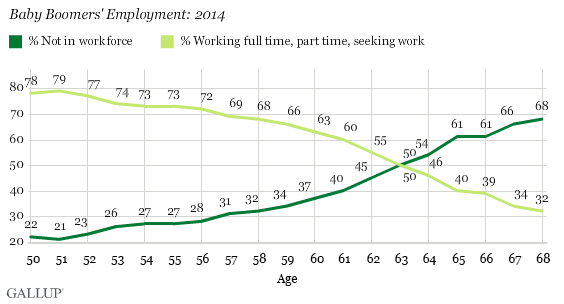
PRINCETON, N.J. — The first members of the huge baby-boom generation in the U.S. have reached retirement age in recent years, and these older boomers are retiring in large numbers, just as Americans in their mid- to late 60s did a few years earlier. While about eight in 10 boomers in their early 50s are in the workforce, the percentage employed drops to about 50% for boomers who are 60, and the proportion accelerates downward with each year of age thereafter. Only about a third of those aged 67 and 68 — the oldest boomers — are still working in some capacity.
The Tax Foundation put together a chart showing how federal tax dollars were spent.

Compare that to 1962 federal spending

Mark J. Perry over at Carpe Diem Blog shows an amazing stat on the economy of Houston, Texas.
AMAZING CHART: From 2011 to 2014 (Jan-Oct), there have been more single-family permits issued in Houston than in CA http://t.co/5Abjn5vy0f—
Mark J. Perry (@Mark_J_Perry) December 03, 2014
This blog has chronicled how lawyers get rich taking in Social Security Disability claims.
Now CNSNews has come out with some new SS disability data that raises some doubt if this program has any control:
One in three, or 35.2 percent, of people getting federal disability insurance benefits have been diagnosed with a mental disorder, according to the latest data from the Social Security Administration (SSA).
Washington, D.C., the seat of the federal government, ranked in the top-ten list of states where disabled beneficiaries were diagnosed with mental problems.
In 2013, the latest data from SSA show there were 10,228,364 disabled beneficiaries, up 139,625 from 2012 when there were 10,088,739 disabled beneficiaries.
Disabled beneficiaries have increased 49.7 percent from a decade ago in 2003 when there were 6,830,714 beneficiaries; and the number is up 14.3 percent from the 8,945,376 beneficiaries in 2009, the year President Obama took office.

Here is another chart showing how big the disability fund has grown in the last ten years.

Chalkbeat Indiana did an in depth write up pertaining to school funding in Indiana. I’m posting some graphs the author laid out in showing grade scores and performance between IPS and Carmel school systems. IPS is being shown as one of the poorest (families avg $20k/yr) while Carmel is one of the wealthiest (families avg $60k/yr). What makes this fascniating is the school systems are right down the road from each other.
The graphs are self explanatory. The second one shows funding to each school with IPS getting almost $3,000 more per student then Carmel students. The author links that since Carmel residents make more money and have more access to “private tutors” their scores are higher. While that maybe one factor, what this write up does not take into account is the role of having intact families. Two thirds of IPS children live in single parent homes. Carmel has only about 10% single parent homes. An amazing stat that needs to be brought into perspective.


In December I posted a blog about why gas prices will go back up and it received numerous hits. The content of that post is now playing out. Mark J. Perry just released some data of oil rigs being shutdown due to the drop in price of crude oil. Here is what he found:

US Oil Rigs Fell Last Week to 1,317, Down 292 and 18% from October Peak of 1,609
This is a quick reversal so I wouldn’t be surprised if 500 shutdowns happen before March. With production falling and the strength of the dollar in question, crude oil will eventually start rising.
With fuel prices dropping over the last several months, many shoppers are asking why food prices have not shown corresponding drops in prices. The asnwer may surprise you in how much fuel costs affect grocery store bills.
Annemarie Kuhns with the Agriculture Department’s Economic Research Service is reporting that only 4.7 cents of every dollar spent at the supermarket goes toward food transportation costs
So less than 5% of your bill is attributed to fuel costs.

