Live in Luxury While the World is Burning

Whether you believe in total economic collapse, government anarchy or the climate will implode there are options out there in how to make it through tough times. Many will have to become “Daryl” in order to survive, but those with money will have another option.

Via the Wall Street Journal (I encourage to click the link for more stories of buyers)

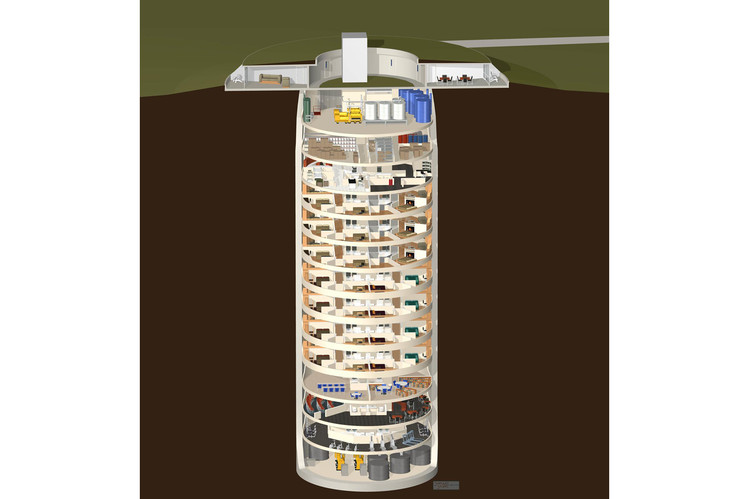
When Tyler Allen agreed to fork over $3 million in cash for a luxury condominium near Concordia, Kan., he wasn’t attracted by the indoor swimming pool, 17-seat movie theater, or hydroponic vegetable garden.
The real selling point of the 1,820-square-foot apartment: It will be buried 174 feet underground in a decommissioned missile silo sturdy enough to withstand a nuclear attack.

Mr. Allen, a 45-year-old Orlando, Fla., sports bar and nightclub owner, insists he isn’t a “tinfoil hat-wearing” type preparing for the end of the world. Rather, he cites growing security threats—such as a global health pandemic, cataclysmic weather and terror attacks. “There’s a Camp David for the president,” he says. “If you’re at a certain level where you can afford it, you can get that, too.”

The so-called Survival Condo complex boasts full and half-floor units that cost $1.5 million to $3 million each. The building can accommodate up to 75 people, and buyers include doctors, scientists and entrepreneurs, says developer Larry Hall.

Safeguarding your home is not just a niche anymore, revenue in the this type of business field is rising.

Spending on residential security rose from $7 billion in 2001 to $12 billion in 2011, and is projected to climb above $16 billion in 2016, according to Freedonia Group, a market-research firm based in Cleveland. That covers everything from routine security devices to the kind of reinforced chambers that gained widespread attention more than a decade ago and were featured in the 2002 film “Panic Room.”

Here are some photos:
prepping
prepping 2

$995 Million Divorce Settlement

Via Reuters –

An Oklahoma County judge has ordered oil magnate and Continental Resources Chief Executive Officer Harold Hamm to pay nearly $1 billion in a divorce judgment, according to a court filing made public on Monday.

Special Judge Howard Haralson found that Hamm should pay his ex-wife Sue Ann Hamm a total of $995.5 million, with about a third of the funds, or $322.7 million, to be paid by the end of the year, the filing says.

Hamm will then be required to pay the rest of the judgment, some $650 million, in installments worth at least $7 million per month, the filing says. Sue Ann Hamm has already been awarded around $25 million since the case was filed in 2012, the filing says.

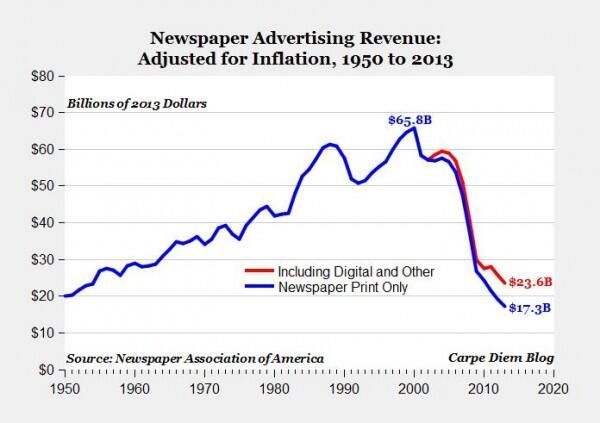
Chart Showing Why Newspapers Are Failing

Pick up a newspaper today and it’s awful. The journalists are “Social Justice” evangelicals and the stories are stale. Economics plays into that because ad revenue is heading towards the Internet (blogs, podcasts and online news) and leaving scraps behind for newspapers. This leaves them to hire the undesirables in reporting. Here is a great graph illustrating newspaper demise.

image

1960’s McDonald’s Menu

Credit Twitter Page “Historical Pics” (@historicalpics)

image

Why Government Supports Minimum Wage Increases

image

Tuesday, five states voted to hike minimum wage for workers. The common theme is that government really cares for the people. Not exactly. Government likes minimum wage increases because it means more taxes collected. Here is example:

“The minimum wage increase is not just the dollar an hour, but it’s also a raise in our taxes,” said Jason Lerner of Little Learner Academy. His family owns five child care centers in New Jersey, where the minimum wage rose from $7.25 to $8.25 on Jan. 1.
In total, these taxes add an extra 10.5% to Little Learner Academy’s payroll expenses.
Take Social Security. Employees have 6.2% of their wages withheld from each paycheck for Social Security. But what they don’t see is that their employer also chips in, matching the 6.2%. For Medicare, both the employer and the employee pay 1.45% of the wage.

Payroll taxes are a big concern when running a business. This tax is also regressive when managing a business. On top of this tax, business owners must also pay to the state disability/unemployment taxes based upon amount of employees they have.

Many years ago I had a boss tell me that payroll is the #1 controllable expense. When payroll goes up and sales don’t, payroll gets slashed.

Day After Elections: Keystone Pipeline Stock Jumps

2014 Republican mid term landslide victory gave oil investors confidence in the Keystone Pipeline finally being approved. Investors over night plowed money into the stock of Trans-Canada.
Credit Lachlan Markay, Washington Free Beacon for pic

image

Chicago Gets Alcohol Delivery

image

After raising almost $2 Million in startup money the company Minibar is now delivering alcohol to customers in Chicago.

Minibar, a startup one-hour delivery system for wine, spirits and beer, has arrived in Chicago.

Minibar says it connects users with local vendors who can deliver within an hour. Orders are placed via the company’s website, http://www.minibardelivery.com, or its mobile app (iOS and Android). Minibar also offers recommended pairings, cocktail recipes and the option to send gifts.

How the Federal Government Sells it Debt

image

In the United States, the federal government not having enough money for spending is the new normal. One thing that never gets discussed is how the government sells its debt in the form of “bonds”.

What may surprise many is that banks and other financial institutions  do it for the government and they are called “Primary Dealers”. Once the government has a certain amount to sell, these dealers take it to market and sell it. Here is the list of dealers:

Bank of Nova Scotia, New York Agency
BMO Capital Markets Corp.
BNP Paribas Securities Corp.
Barclays Capital Inc.
Cantor Fitzgerald & Co.
Citigroup Global Markets Inc.
Credit Suisse Securities (USA) LLC
Daiwa Capital Markets America Inc.
Deutsche Bank Securities Inc.
Goldman, Sachs & Co.
HSBC Securities (USA) Inc.
Jefferies LLC
J.P. Morgan Securities LLC
Merrill Lynch, Pierce, Fenner & Smith Incorporated
Mizuho Securities USA Inc.
Morgan Stanley & Co. LLC
Nomura Securities International, Inc.
RBC Capital Markets, LLC
RBS Securities Inc.
SG Americas Securities, LLC
TD Securities (USA) LLC
UBS Securities LLC

So next time you hear a politician claim banks or financial institutions are evil, they are the ones selling the debt to help that same politician in their spending addiction.

Premium Costs Before and After Obamacare

In analysis published this week, the website HealthPocket.com compared the average premiums people paid in 2013, before Obamacare plans went on sale, to 2014 plan prices. HealthPocket looked at premiums paid by non-smoking men and women, ages 23, 30 and 63, in all 50 states and Washington, D.C.

“HealthPocket found that the average health insurance premium increased by double digits for each group examined, though some groups saw a much steeper increase than others,” the report said.

For 23-year-old non-smoking men, the average premium for all plans jumped 78 percent in 2014, the report said. Women of the same age saw a 45-percent hike.

For 30-year-olds, the increases were 73 percent for men and 35 percent for women. Only the 63-year-old age group saw bigger price hikes for women, with females paying 37.5 percent more for insurance on average in 2014, and men paying an average of nearly 23 percent more.

Read the rest at CNBC