Inflation at Indiana Cattle Stockyards

Obtained some pricing from a person involved with livestock being brought in and sold at a stockyard in eastern Indiana.

Last week top grade cattle were getting $1.50/lb when brought in for sale. Just six years ago same person said going price was around .50/lb.

Stocking up on meat this winter would not be a bad idea.

Indiana Alcohol Industry Has a New Player: Artisan Distillery

Last year Indiana lawmakers relaxed some rules in allowing investors and alcohol makers open up distillery operations to make whiskey. Now some operations have popped up and the specialized business of the alcohol industry will have to wait and see how it all plays out financially.

Here is how the alcohol rules got relaxed

They pointed to states such as Michigan, where 32 small distillers sell local spirits and generate tourism dollars and tax revenue. Kentucky’s “Bourbon Trail” attracts 400,000 visitors to distilleries, which buy more than 2 million bushels of Indiana corn, each year.

The law that went into effect in July 2013 allows an artisan distiller to produce no more than 10,000 gallons of liquor for retail sale a year. The distiller cannot sell spirits to a retailer or a dealer but must sell by the drink, bottle or case on the premises.

Unlike big craft-spirit operations that buy liquor from wholesalers then flavor, bottle and label it as their own, the products of Indiana’s artisan distilleries must be homegrown. At least 60 percent of the final product must be fermented and distilled from raw materials on-site.

So far five permits have been granted and seven more are awaiting approval. The investors must also already have a federal permit for the process. Investments into the operations can run as high as $500,000.

The most important thing to remember of this new business venture for Indiana alcohol consumers, the bourbon and whiskey are still aging. Only when the first batches are tasted will indicate success of this new expansion.

Hat Tip Indiana Economic Digest
Saudi Arabia: Nuclear/Solar Power Expansion

Saudi Arabia has recently announced a very aggressive plan to start introducing nuclear power plants and big solar farms into their power supply grid to replace hyrdrocarbons. I find it insane the U.S. does not pursue nuclear energy in all forms. It would stabilize the entire country and be a source of power for decades to come. Here is the entire article but will pass along the highlights.

The Saudi Royal Family hopes that nuclear will provide 15% of the Kingdom’s power (18 GWe) within 20 years, together with a similar 15% (40 GWe) from solar. They are planning to invest $80 billion to build over a dozen nuclear power plants as fast as possible, intending for the first reactor to come online in only eight years. Investment in solar for the same energy production will take about $240 billion in investment, although breakthrough technologies in the next decade should cut that cost in half.

Total electricity consumption in Saudi Arabia exceeds 200 billion kWhs per year and is expected to double by 2030

Two largest uses of power in the Middle East are for desalinating seawater and residential cooling. Saudi Arabia desalinates over 250 billion gallons of seawater each year, and that number will double in the next ten years as the population and industrialization increase.

Saudi Arabia burns almost a billion barrels of oil a year to produce electricity

Saudi’s neighbor, Abu Dhabi in the United Arab Emirates started towards the solar/nuclear combination as well. Here is an interesting note to show how much solar it takes to equal nuclear power

Recently the UAE opened what was, at the time, the largest solar plant in the world, the 100 MW Shams 1 at a cost of about $600 million. But two hundred Shams 1 arrays will be needed to equal the output of the four Barakah nuclear reactors.

How Many U.S. Golf Courses Are Closing Yearly?

Several times during the last few months while listening to sports talk radio I would hear the claim that “400 golf courses are closing yearly in America”. This went along with the theme that golf participation is declining and younger Americans are not joining clubs while current members are getting too old for the game. This peaked my interest because the claim of 400 a year is a lot of golf courses. So I decided to research it and find out what was happening. Bloomberg News had a nice write up back in January of this year and here is what they found:

More golf courses closed than opened in the U.S. in 2013 for the eighth straight year, according to the National Golf Foundation.

A total of 14 18-hole courses opened last year, up from 13.5 in 2012, while 157.5 courses were closed during the year, three more than a year earlier, the Jupiter, Florida-based organization said in a statement on its website. The organization counts every nine holes as 0.5 of a course.

Since 2006, course closings have outnumbered openings after more than 4,500 courses had opened over the previous 15 years. Those courses, many of which were built as part of real estate projects, shut down as the U.S. recession led to a reduction in home sales needed to support the courses. Golf club memberships and rounds played also declined during the recession.

Of the closings, 66 percent charged less than $40 for greens fees during peak times. The closings decreased the total number of U.S. golf courses to 14,564.5, the Foundation said. Public courses made up 97 percent (151.5) of the closures, with private courses accounting for 4 percent (6). A total of 8.5 public courses opened last year, compared with 5.5 new private courses.

Since 2006, 643 18-hole courses have closed, the organization said. The decline has followed a 40 percent growth from 1986 through 2005, a period with more than 4,500 courses opening, according the foundation data.

So while golf courses are closing, not at the exent the ESPN radio host is making it out to be.

United States YTD Interest on Debt Payments

Month of August Interest on Debt payment was $27,093,517,258.24. Fiscal YTD payments now stand at $411,217,855,816.94. There is one fiscal month left for 2014.

Soure: Twitter page @USGovtInterest

CDC Stats of Children Born to Unwed Mothers

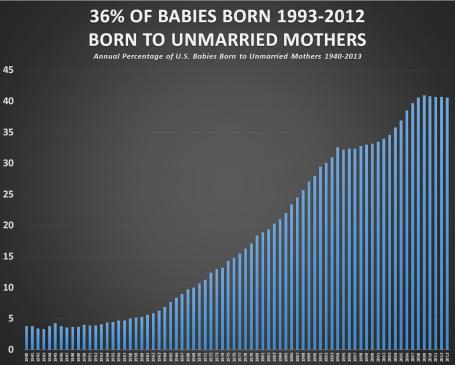
BABIES BORN TO UNMARRIED MOTHERS-1940-2013-PHOTO

In 2013, 40.6 percent of babies (1,605,643 out of 3,957,577) born in 2013 who were also born to unmarried mothers. Since 2008 the births of babies to unwed mothers has topped 40% or higher. Compare this to the 1940 number of 3.8% with it only jumping to 5.3% 20 years later in 1960. Once the welfare programs of the “Great Society” were introduced in the mid 60’s the number of unwed mothers having babies jumped to 14.3% by 1975.
From 1983 to 2008 the percent of unwed mothers having babies went from 20 to 30 percent.

The reason babies born to unwed mothers is critical to watch with a nations economics is because historically this group gets government benefits in the form of welfare, WIC, housing, etc. Even the government has stated this in a recent report:

In its latest annual report to Congress on “Welfare Indicators and Risk Factors,” the Department of Health and Human Services pointed to the high rate of births to unmarried mothers, saying “data on nonmarital births are important since historically a high proportion of welfare recipients first became parents outside of marriage.”
“Historically a high percentage of AFDC/TANF recipients first became parents outside of marriage,” said this HHS report.

To back up the governments statement on this is earlier in the month it was reported that the US Government welfares roles had grown to 109 million citizens.

Hat Tip to CNSNews for the data.

Indiana Corn Harvest Begins

Hoosier Ag interviewed  Dan Emmert, field agronomist with DuPont Pioneer and he reported the following:

Harvesting has begun and early yields look good. Emmert says several fields along the Ohio river have been harvested, “Only the guys who are comfortable harvesting corn at around 20% are willing to start this early.” He expects most growers in SW Indiana to begin to work fields in about 3 weeks.

H&R Block: Yeah Taxes Will Get More Complicated Because of Obamacare

H&R Block confirmed what many predicted would happen with the new health care law enacted 4 years ago: make taxes even more complicated.

Speaking on H&R Block’s quarterly earnings conference call, CEO William Cobb said that the company was already taking steps to train its tax preparers based on the draft forms that the Internal Revenue Service has released to comply with Obamacare.

“As expected, the forms are very detailed and can present significant complexity, depending on a filer’s coverage status during the year, income level, and household composition,” Cobb said. “Depending on their situation, there are instances where filers may need to file multiple new tax forms and complete additional worksheets.”

And he wasn’t he wasn’t finished…

“Depending on the type of exemption, the process to claim it could be quite cumbersome and time consuming,” Cobb said.

Colorado Pot Tax Revenue Prediction Goes Up In Smoke

Colorado government tax revenue prediction was off for the first six months of legalized pot sales. They were only off by about 70%.

Via CBS4 Denver

When voters approved recreational marijuana sales the state predicted it would pull in more than $33 million in new taxes in the first six months. The actual revenue came up more than $21 million short.

Numbers from Illinois Teachers Pension Fund

Illinois is a broke state and their teacher pension fund does not make things any easier on how it is contractually written. Yes, it is a contract and the state is honoring the pension as of right now. In the spirit of “States Rights” the voters of Illinois find their financial situation very pallable no matter the current conditions or what they will be facing as the physics of economics plays out. This blog is not making fun of Illinois but it also will not give pity to the residents when debt hell hits.

The Washington Times had a long article showing the ramifacations of this current penson plan that they operate on. I will post the key financial highlights of it while you can read the rest in the embedded link.

About 6,000 retired educators collecting more than $100,000

More than 100,000 retired Illinois educators had been paid back what they invested into the system just 20 months after leaving work

The pension is about $54 billion underfunded

The teacher pension’s 3 percent annual increases aren’t tied to inflation — meaning they cannot fluctuate up or down depending on the economy or budget pressures.

Illinois public sector workers will receive, on average, a $1,906 annual cost of living adjustment this year — nine times more than the average Social Security beneficiary