Percent of Fuel Cost in Your Grocery Store Bill

With fuel prices dropping over the last several months, many shoppers are asking why food prices have not shown corresponding drops in prices. The asnwer may surprise you in how much fuel costs affect grocery store bills.

Annemarie Kuhns with the Agriculture Department’s Economic Research Service is reporting that only 4.7 cents of every dollar spent at the supermarket goes toward food transportation costs

So less than 5% of your bill is attributed to fuel costs.

Food Stamps Usage Increasing

Food stamp usage is on the rise again in America. Rough estimate of what the federal government spends is around $77 Billion a year. What makes this news worthy is it conflicts with the notion that the economy is in great shape. Another problem is the program is very lax on rules and has become a new “social justice” program.

Here is more from CNSNews.com

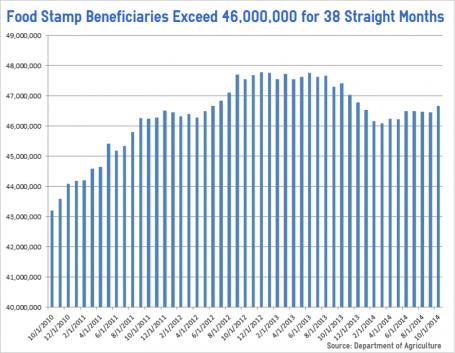
The number of beneficiaries on the Supplemental Nutrition Assistance Program (SNAP)—AKA food stamps–has topped 46,000,000 for 38th straight months, according to data released by the Department of Agriculture (USDA).

In October 2014, the latest month reported, there were 46,674,364 Americans on food stamps. Food stamp recipients have exceeded 46 million since September 2011.

image

If you don’t believe this program isn’t somewhat over used, let this stat sink in:

In 1969, the average participation in the SNAP program stood at 2,878,000. In 2014, average participation grew to 46,536,000 showing an increase of 1516.96 percent.

Indiana Governor Pence Submits 2016 – 2017 Budget

Indiana Governor Mike Pence submitted his budget proposal to the House and Senate for approval. The two bodies will debate the bill and then vote on a final budget at a later date.

I went over to the PDF file the state put out on overall spending areas of the budget. The one big glaring issue is the amount of federal funding the state receives for whatever programs are tied with that. Many people will argue that it captures the money Hoosiers pay in federal taxes and brings it back in the state. In that case, the money shouldn’t leave peoples paychecks at and just have it working economically in the first place.

Here are some budget numbers I found in the proposal. The proposal is for fiscal years 2016/2017:

Both years will cost Hoosier’s around $62 Billion

Education will eat up about 33% of the budget with spending projected at $22.5 Billion

Welfare (Food Stamps, Welfare, Medicaid, etc.) is projected at $28 Billion. $19 Billion of that is sent to Indiana by the Federal government. Start grasping we spend more on welfare then education.

Public Safety spending for the budget cycle is $3 Billion. I know Indiana prisons got more money but expect that to go up throughout the years. Criminals now have to serve 75% of the sentences.

The Governor’s office projected federal funds contributing to the budget for a total of $24.9 Billion.
How Much Do Consumers Pay to Healthcare Providers?

Just Facts Daily posed a question to readers regarding healthcare payments. Here is the question and answer:

What portion of all healthcare spending in the U.S. is directly paid by consumers to healthcare providers (i.e., not indirectly paid through middlemen like insurance companies or governments)?

Less than 25%

In 2009, consumers directly paid for 12% of all healthcare spending in the U.S., as compared to 48% in 1960. This trend has been driven by government policies and is a major factor in the rise of healthcare spending, because it reduces consumers’ incentive to shop for the best value.

Medicaid Eating Up State Budgets

Medicaid spending in state budgets is becoming the largest line item costs in many state governments. State Budget Solutions had this national average stat:

Though the federal government provides some Medicaid funds via matching rates, this welfare program has been taking up a larger and larger share of state budgets in recent years. In fact, Medicaid is the largest category of state spending, accounting for 23.6 percent of state budget expenditures according to the National Association of State Budget Officers.  That percentage is likely to increase over time.

Indiana currently spends over 27% of their budget on Medicaid.

CDC Stats of Children Born to Unwed Mothers

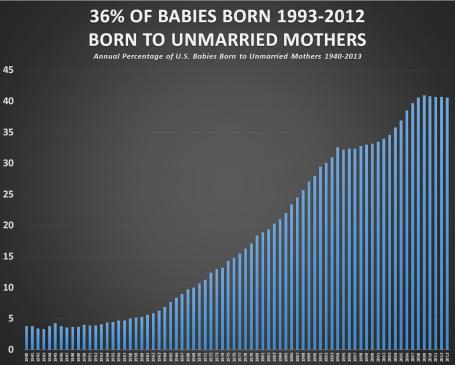
BABIES BORN TO UNMARRIED MOTHERS-1940-2013-PHOTO

In 2013, 40.6 percent of babies (1,605,643 out of 3,957,577) born in 2013 who were also born to unmarried mothers. Since 2008 the births of babies to unwed mothers has topped 40% or higher. Compare this to the 1940 number of 3.8% with it only jumping to 5.3% 20 years later in 1960. Once the welfare programs of the “Great Society” were introduced in the mid 60’s the number of unwed mothers having babies jumped to 14.3% by 1975.
From 1983 to 2008 the percent of unwed mothers having babies went from 20 to 30 percent.

The reason babies born to unwed mothers is critical to watch with a nations economics is because historically this group gets government benefits in the form of welfare, WIC, housing, etc. Even the government has stated this in a recent report:

In its latest annual report to Congress on “Welfare Indicators and Risk Factors,” the Department of Health and Human Services pointed to the high rate of births to unmarried mothers, saying “data on nonmarital births are important since historically a high proportion of welfare recipients first became parents outside of marriage.”
“Historically a high percentage of AFDC/TANF recipients first became parents outside of marriage,” said this HHS report.

To back up the governments statement on this is earlier in the month it was reported that the US Government welfares roles had grown to 109 million citizens.

Hat Tip to CNSNews for the data.

Census Bureau: 109 Million on Welfare

The Census Bureau released their fourth quarter 2012 results and found 35.4% of all Americans to be receiving welfare. Here is more from a lengthy CNSNews Report.

109,631,000 Americans lived in households that received benefits from one or more federally funded “means-tested programs” — also known as welfare

The number jumps when other programs are added in:

When those receiving benefits from non-means-tested federal programs — such as Social Security, Medicare, unemployment and veterans benefits — were added to those taking welfare benefits, it turned out that 153,323,000 people were getting federal benefits of some type at the end of 2012.

Here is a breakdown of what welfare program is received by Americans and how many on it:

82,679,000 Medicaid
51,471,000 Food stamps
22,526,000 Women, Infants and Children program
20,355,000 Supplemental Security Income
13,267,000 lived in public housing or got housing subsidies
5,442,000 got Temporary Assistance to Needy Families
4,517,000 received other forms of federal cash assistance.