Food Chains Hit By Inflation

Inflation is being reported amongst the bigger food chains this past month. This will ultimately lead to higher costs for the consumer.

CNBC reported in Mid August:

“Food retailers like Red Robin Gourmet Burgers and Noodles & Company are sounding the alarm on inflationary pressures, raising the question: Is this the start to higher food prices for consumers?

“Official data show inflation only gradually rising for the economy as a whole with the personal consumption index gaining 1.6 percent in June; however, a dozen food companies in the past few weeks have warned steeper price hikes hurt results last quarter.

Prices are rising for several restaurant staples like beef, seafood and cheese. But costs aren’t up everywhere: Grain and vegetable prices, for example, have been declining.

“This morning Red Robin said lower margins, which fell 1.3 percent from the same period a year ago, were mainly due to higher food and beverage costs.

“Noodles & Company, which reported last night, posted a two percent drop in margins due to increased costs. During the company’s conference call, CFO Dave Boennighausen said the cost of goods sold rose 70 basis points last quarter as a result of modestly higher pork, dairy and shrimp ingredient costs, as well as more promotional activity.

“Wholesale food inflation rose 4.2 percent in the first six months of the year, its steepest rise since 2011; however, menu and grocery prices – what consumers are paying – were only up 2.2 percent and 1.6 percent, respectively, in the same period, according to the National Restaurant Association.”

These are striking numbers considering the purchasing power(Economies of Scale) these chains have compared too smaller food retailers. The smaller ones which most refer to as “Mom & Pop” will not be able to keep up as inflation keeps increasing. The consumer is still feeling squeezed on normal groceries going up in price. Eating out is a very easily controlled expense to decrease.

Social Security Disability Insurance Fund Will Be Depleted in 2016

Charles Blahous of the Manhattan Institutue recently reported on some findings from the July 28th Social Security Trustees annual report. Social Security and Medicare are two government programs that have been long embedded in government spending. These programs are political hot topics whenever they are suggested to be “reformed” or made more efficient, political dogma ensues. Changes for the most part of these programs are made to give MORE benefits to people and not a regression. I will take some information from Mr. Blahous write up which he did testify in front of Congress about and then turn to two other sources for completion of this summary.

The public must understand the breakdown of how Social Security functions when pertaining to funds

Social Security has two trust funds. Payments for retired workers as well as spouses, children and survivors are made from the Old-Age and Survivors (OASI) trust fund. Payments for disabled workers and their dependents are made from the Disability Insurance (DI) trust fund. It has become commonplace to refer to the two trust funds’ combined operations as though they were one fund. This nomenclature is convenient but not truly accurate. By law each of the two trust funds must separately have a positive balance to allow them to make benefit payments.

Here is big point for people to grasp about this trust fund. Many people who support Social Security at any cost claim the program has too by “law” go on forever no matter what funding issues arise. That is true to a point and here is that BIG point. Once funding for the SS Disability Insurance fund starts going in the red, payments can be greatly reduced “BY LAW”.

The trustees have been warning for several years (long before I became one) that Social Security is on an unsustainable financial trajectory. We have now moved from a long-term problem to an immediate one. The DI trust fund is currently projected to be depleted in two years, in the fourth quarter of 2016. At that point, unless the law is changed disability payments will drop suddenly by 19 percent.

I would suggest reading Charles Blahous article (A Guide to the 2014 Social Security Trustees Report) a few times and even take some time to ponder it. It is a very nice write up and one to keep on file for further events.

Social Security and Medicare produce reports and the federal government then puts together a summary(Status of the Social Security and Medicare Programs) of these two reports. Here are some highlights of the summary pertaining to just Social Security.

Neither Medicare nor Social Security can sustain projected long-run pro- gram costs in full under currently scheduled financing

Social Security and Medicare together accounted for 41 percent of Federal expenditures in fiscal year 2013

The Trustees project that this annual cash-flow deficit will average about $77 billion between 2014 and 2018 before rising steeply as income growth slows to its sustainable trend rate after the economic recovery is complete while the number of beneficiaries continues to grow at a substantially faster rate than the number of covered workers.

In October 2013, “60 Minutes” reporter Steve Kroft did a segment called “Disability, USA”.  If you have not seen it, I suggest you take a look at the SS disability situation happening in America.

Final summation: For years many Austrian Economic students have talked about the Social Security situation. They are usually met with resistance by economic pundits who produce wild and complicated graphs that say everything is o.k. Problem with this belief is it defies reality. Real money is being given to real people. This program has real issues that cannot be delayed as the physics of debt take over.

Year To Date Federal Government Deficit $460 Billion

The United States Treasury just released up to date tax revenue collection relating to 2014 fiscal government budget. 2014 government budget ends in September.
CSN News provides a more detailed analysis:

Inflation-adjusted federal tax revenues hit a record $2,469,178,000,000 for the first 10 months of the fiscal year this July, but the federal government still ran a $460,450,000,000 deficit during that time, according to the Monthly Treasury Statement.
After the current fiscal year, the second highest federal tax intake in the first 10 months of a fiscal year occurred in the first 10 months of fiscal 2007, when the government collected $2,432,115,460,000 in 2014 dollars – or $37,062,540,000 less than in the first 10 months of this fiscal year.

The total dollar amount already spent by the government stands at $2,929,628,000,000.

You can read the rest of the article here.

The Nine Pound Gold Shirt

Sometimes in life it’s o.k. to splurge on clothes shopping. But one man did it in a big way and Economic Policy Journal lays out the details:

Pankaj Parakh owns a pure gold shirt worth about £127,000 (roughly $213,000).He had it custom-made for his 45th birthday. The shirt, made out of 18-22 carat gold, weighs more than four kilograms (nearly nine pounds). The gold itself is 18-22 carat purity, and there have been no other metals used. It is lined with a thin cloth for added comfort

image

Graph of the Day: Next Market Crash

image

John Maxfield  from theThe Motley Fool penned an article in the USA Today that shows an enticing graph of potentially the next big crash in the markets.

Austrians economic disciples have been screaming the last decade about the Federal Reserve’s printing or now digitizing of money to the banks through borrowing. On top of that, the federal government has needed massive amounts of money to fund welfare/social programs that are by law “mandatory”.

Maxfield and Austrians part ways with his explanation in the article. There really is no more denying inflation is happening. Pricing is exploding across many sectors.

Personally, I have followed the Feds printing and done well. But the money supply is drying up and a downturn is very real down the road

United States Government YTD Interest on Debt Payments

The U.S Federal Government makes monthly payments on “interest on debt” to its lenders that they borrowed money from. The payments do not include paying down the principle.

For the month of June 2014, $97,565,768,696 was paid out with YTD total now at $354,863,250,628. There are still 3 fiscal months left for 2014 of the U.S. government.

Source – United States Treasury Department

Indiana’s Neighbor Illinois Needs To Mow Their Lawn

Standard & Poor’s Ratings Services again has threatened the state of Illinois to get their financial mess in order or else it will downgrade their bond ratings. Once you are downgraded, your borrowing rates go up making it more expensive to borrow. That means more of their yearly budget will be diverted to paying off interest and debt.

The credit rating agency affirmed the state’s worst-in-the-nation A- bond rating, but its outlook, which had been raised to “developing” earlier this year after enactment of pension reforms, went back to negative.
That means that the state’s credit rating could be downgraded within the next two years unless its finances improve, S&P said. A lower credit rating translates into higher borrowing costs.

Illinois biggest issue is their health pension system which is not sound financially. The Illinois Supreme Court recently had this to say:

“The Illinois Supreme Court was clear in its opinion that the health insurance subsidies paid by the state for retiree health care are a benefit derived from membership in a state pension plan and therefore subject to the Illinois Constitution,” S&P said.

S&P has stated that if the state comes to together for serious reform, then it would most likely revisit upgrading their status. Illinois has a big backlog of bills that already need paid and their most recent budget enacted will produce more deficits. They have used many gimmicks to reassure vendors/creditors in collecting tax revenue while doing bad borrowing schemes in the form of borrowing against future sales tax revenue.

I do not see Illinois changing its bad habits anytime soon.

Is Mexico Going To Silver?

Silver overall is a great investment to protect yourself against inflation. Just 6-7 years ago people were saying it would never go above $14/oz. Now it sits around $20/oz with many investors saying it’s severely undervalued.  Here is one piece of news pertaining to silver:

Investor and industrial consumption of silver has advanced at a healthy pace in 2014, so far. The silver price is up  5 percent as of July 15 from the beginning of the year. Globally, silver bullion coin sales are up 4.5 percent through the 1st quarter of 2014, according to precious metals consultancy Thomson Reuters.  U.S. Mint sales of American Eagle Silver Bullion coins maintained near record level sales, totaling 24.1 Moz for the first six months of 2014, just shy of the 25.0 Moz sold in the first half of 2013.

Last few months been picking up chatter about Mexico potentially backing their peso with silver. The website Economic Policy Journal ran a piece addressing the issue:

For many Americans the country of Mexico conjures up images of a third world nation. The poverty, lack of basic services, and extreme violence has left the populace so desperate that thousands of people on a daily basis head to the United States for a better life. But according to Future Money Trends, all that could change in the near future as key Mexican financial leaders and politicians have been working to institute sweeping monetary change that, if implemented, could unleash a global power shift of epic proportions.

Not a popular subject to discuss here in the U.S. is the rest of the worlds disgust with the devaluing of the American dollar through our Federal Reserve while racking up major debt. Many countries have now started trading in their own currencies:

Like recent monetary shifts in Russia, China and the middle east that aim to divest themselves of US dollar reserve trade requirements, the news of such a move in Mexico has been downplayed. And though it is being generally ignored as a serious possibility, a powerful consortium of influential people in Mexico believe it is a realistic possibility, and one that could be responsible for shifting the balance of world power.

You can read the rest of the article here.

If this ever got serious, Silver would be the major investment to be in along with Mexico markets. World Central Banks will put up a major fight in not letting this happen.


Price of Beef and Bacon Reach All-Time High

Per CNSNews.com 

The price of beef and bacon hit its all-time high in the United States in June, according to data released Tuesday by the Bureau of Labor Statistics (BLS).
In January 1980, when BLS started tracking the price of these commodities, ground chuck cost $1.82 per pound and bacon cost $1.45 per pound. By this June 2014, ground chuck cost $3.91 per pound and bacon cost $6.11 per pound.

A decade ago, in June 2004, a pound of ground chuck cost $2.49, which means that the commodity has increased by 57 percent since then. Bacon has increased by 78.7 percent from the $3.42 it cost in June 2004 to the $6.11 it costs now.

Beer Prices Hit By Inflation

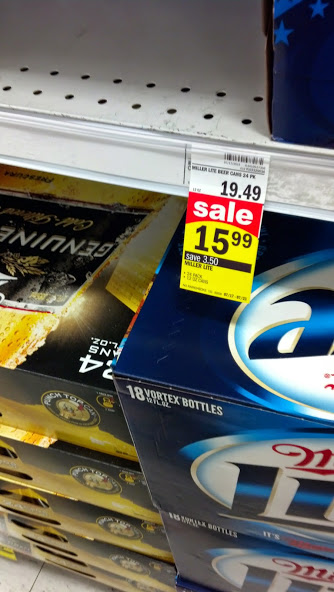
Beer Inflation

You don’t have to be an economist to understand inflation is hitting at all levels over the past 7-10 years. The grocery store is a place where consumers can feel the pinch. Inflation just isn’t prices going up either. Another side of inflation is when the manufacturer reduces the size of the product and yet the price still stays the same.

In my household, we constantly analyze prices at the grocery store when we go to Walmart or Sam’s Club. Prices are going up and some product size is shrinking. The other night when I went to go pick up a case of beer at the local Meijer grocery I was a little shocked at the sticker sale price. Meijer is known as a fair priced grocery store and Indiana overall has stable pricing on various economic segments. The above picture is highest I ever seen. Beer prices overall have been going up in the last 3 years from my observation and if you Google the matter, you will see several articles over the last five years detailing rising beer costs.

Many factors go into the pricing of an item when it sells. Dollar value, taxes, regulation, demand or lack of, material cost, fuel, etc. I did a little research and saw some areas other than dollar weakness contributing to price increase such “hops” being down this year. Why I keep circling back to dollar weakness is because the craft beer sector has exploded which should affect the demand for typical beers. Countless sites have even stated Miller and Budweiser have lost sales over the last few years.

Just watch prices in your area and see the climb.