New Ponzi Scheme: Invest in Government

image
Government wants you to invest in them. President Obama talked of a new investment fund in the past and now, without consent of Congress, has started it up through the Treasury Department. Here is more from the Wall Street Journal:

A form of Roth Individual Retirement Account that allows people to save after-tax dollars and watch them grow tax-free until retirement, the new myRA offers a single investment option. It’s a private version of the G Fund that is available to federal workers and has lately been delivering annual returns of about 2% on its portfolio of Treasury securities.

Government is guaranteeing no fees to the investor. That is political code for the taxpayer will subsidize it.

Treasury is funding the program out of the budget for its Bureau of the Fiscal Service. The assertion here is that existing law allows this part of the Treasury to hire financial agents as part of its mission to efficiently finance the federal government.
Taxpayers are covering the costs, though their elected representatives in Congress never voted to create the program. So far Treasury also hasn’t told us the fees it is paying Comerica.

Competition Has Driven Technology Prices Down for Consumers

1964 christmas

Economist Mark J. Perry at the American Enterprise Institute provided a piece showing the technology marketplace and how competition helps not only bring more products to the marketplace but also cheaper pricing.

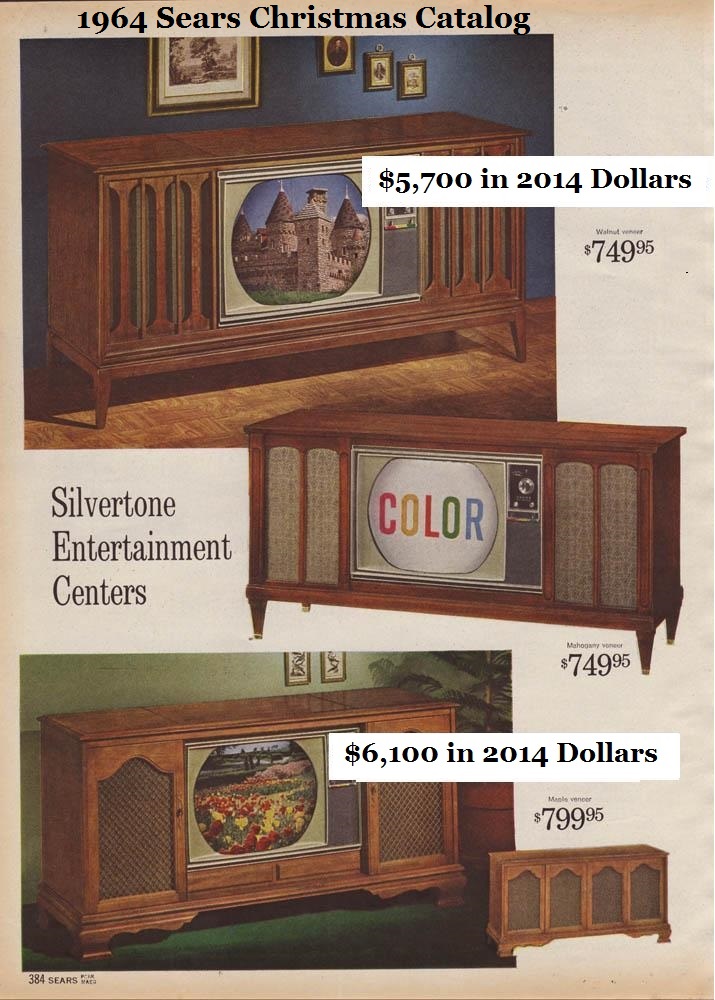
Pictured above are some color TVs from the 627-page 1964 Sears Christmas Catalog, available here at the WishbookWeb website along with many other Christmas catalogs from 1933 to 1988. The original prices are listed ($750 for the Sears Silvertone entertainment center and $800 for the more expensive one), and those prices are also shown converted to today’s 2014 dollars using the BLS Inflation Calculator: $5,700 for the basic 21-inch color TV model and $6,100 for the more expensive model.

Click on this link to see what he found you can buy with the amount of money in todays dollars from the televisions listed above.

He also leaves on this final note and one reason why the U.S. is still one of the greatest economic innovators the world has ever seen.

As much as we might complain about a slow economic recovery, the decline of the middle class, stagnant median household income, rising income inequality and a dysfunctional Congress, we have a lot to be thankful for, and we’ve made a lot of economic progress in the last 50 years as the example above illustrates, thanks to the “magic and miracle of the marketplace.”

Middle East Controls American Oil Refinery Business

saudi arabia
While many media pundits are on tv celebrating the U.S. leap in oil production there is another side not talked about, Middle East countries Saudi Arabia and Qatar own most of the oil refinery business in the United States. Here is more from a 2013 Washington Times article:

Today, the largest oil refinery in the United States, Motiva in Texas, is owned by Saudi Aramco (a state-owned company) and Royal Dutch Shell (a British and Dutch company). The refinery recently completed a major expansion project, originally driven by growing American demand for Saudi oil in 2007.

Since the expansion began, however, U.S. demand for oil has fallen and production of North American oil has risen. Saudi Aramco has, therefore, repositioned Motiva to accept this change in the market. In addition to importing Saudi oil, the Motiva expansion allows Saudi Aramco to refine and export petroleum products to Latin American markets. Most important, though, the expansion enables Saudi Aramco to refine the heavy crude oils now being extracted from Canadian and American oil sands and shale fields.

Saudi Arabia is also being joined by Qatar in not only the U.S. but also in Canada:

Qatar is also positioned to extract significant profits from the American energy industry. According to the U.S. Energy Information Administration, Qatar holds the third-largest natural-gas reserve in the world and has been the world leader in liquefied natural-gas technology and exportation since 1997. Yet Qatar Petroleum International (also a state-owned company) owns a 70 percent stake in the Golden Pass re-gasification terminal in Texas. The terminal was previously intended to import Qatar’s natural gas into the United States, but with the boom in North American natural gas, Qatar is now seeking to repurpose the facility to export liquefied natural gas and profit from North American resources. Qatar Petroleum International’s CEO, Nasser al-Jaidah, recently stated that the company is seeking to invest in North American shale, a highly touted source of America’s potential energy independence, and on April 15, the company acquired a stake in Suncor Energy’s natural-gas holdings in Canada.

Why Gas Prices Will Go Back Up

image

As crude oil prices have collapsed over the last few months oil producers have taken notice here in the US. Once oil prices reach a certain point, oil rig operators start shutting down rigs because it cost more to run them then what it’s worth in pumping oil.

Oil tycoon Boone Pickens is a guy you want to follow on predictions in the oil market and he just came out with one reason why oil prices will likely go back up in 2015. Robert Wenzel from Economic Policy Journal pointed to this interview for reference:

Boone Pickens was on CNBC this morning and he noted that some 75 rigs have been laid down, out of a total of around 1,500 rigs operating in the US. He expects that another 500 rigs will be taken out of operation over the next few months.

This is a big swing in oil production and something that needs to be monitored along with the strength of the dollar.

How Much Does it Cost to Operate Guantanamo Bay

Guantanamo Bay houses terrorists captured around the world by the United States military and other intelligence agencies. In 2014 it cost American taxpayers $397 Million.

Inflation Graph: Massive Price Increases Last 14 Years

image

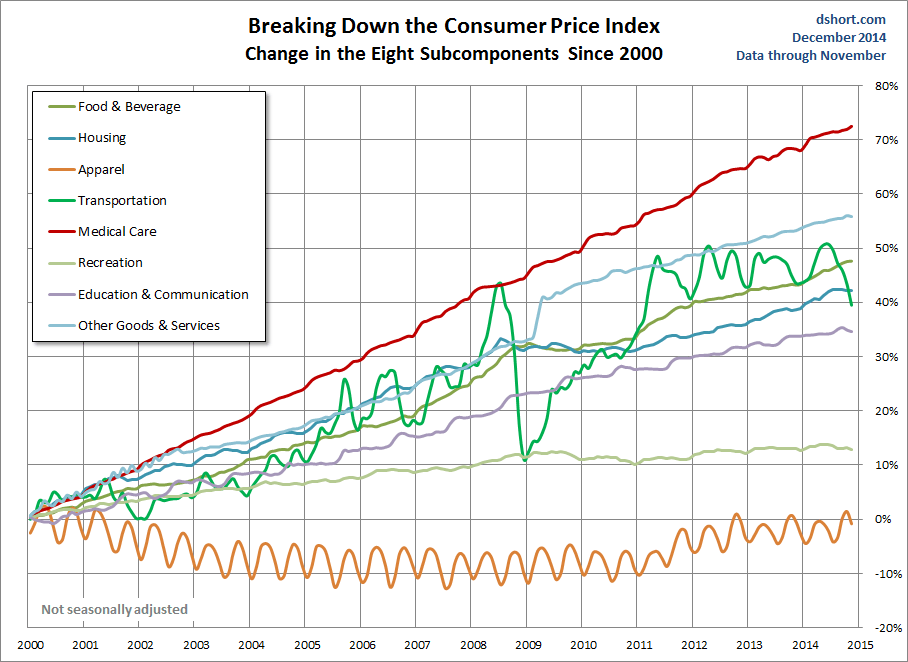
As the Federal Reserve started printing money here is a listing showing how prices took off.

H/T: Economic Policy Journal

How Much Do Consumers Pay to Healthcare Providers?

Just Facts Daily posed a question to readers regarding healthcare payments. Here is the question and answer:

What portion of all healthcare spending in the U.S. is directly paid by consumers to healthcare providers (i.e., not indirectly paid through middlemen like insurance companies or governments)?

Less than 25%

In 2009, consumers directly paid for 12% of all healthcare spending in the U.S., as compared to 48% in 1960. This trend has been driven by government policies and is a major factor in the rise of healthcare spending, because it reduces consumers’ incentive to shop for the best value.

California Pension System Imploding

With Detroit bankruptcy being approved just a few weeks ago look for many other municipalities and possibly states to use similar methods to fend off economically impossible to meet financial demands.
The next bankruptcy is best captured in the LA Times article entitled “California pension funds are running dry” :

The state’s pension goliath, the California Public Employees’ Retirement System, had $281 billion to cover the benefits promised to 1.3 million workers and retirees in 2013. Yet it needed an additional $57 billion to meet future obligations.

The bill at the state teachers’ pension fund is even higher: It has an estimated shortfall of $70 billion.

Bankruptcy has already happened in some California towns.

Meanwhile, cash-strapped cities are facing escalating bills. Rising pension costs contributed to bankruptcies in Stockton, San Bernardino and Vallejo.

The man behind the transparency movement in California is state Controller John Chiang. He started a website tracking a towns finances for the public to see and it grew from there.

Purdue Economics Program Top Ranked

Via jconline.com

Add another top national ranking to the Krannert School of Management at Purdue University.
The masters in economics program at Krannert was ranked 13th in the United States by Financial Engineer magazine.
The rankings were based on Graduate Management Admission Test scores, starting salary and bonus, undergraduate GPA, acceptance rate, full-time graduates employed at graduation, and full-time graduates employed three months after graduation.

College Student Loan Debt Exploding

image

When talking about economic “bubbles” one that is hardly ever mentioned is student loan debt. CreditCards.com had this about the amount of debt:

Debt affects people of all ages, but an explosion of student debt is weighing down this generation of young adults like no other before. According to data from the Federal Reserve, U.S. student loan debt soared from $550 billion in 2007 to nearly $1 trillion by 2013.

An April 2014 Wells Fargo survey reported that 29 percent of millennials (people between 22 and 33 years old) are worried about paying off their student loans, and data from FICO show that the burden of student-loan debts is contributing to a downturn in the number of millennials carrying credit cards.

You can read the rest of the article here.