Graph: Auto Loan Delinquency Rates

Banks are enjoying borrowers paying on their car loans.
image

What An $15/hr Fast Food Worker Looks Like

With fast food workers demanding equality and $15/hr wages being enacted by some major cities, franchisees are now unveiling what their new workers look like:

H/T Economic Policy Journal

Government to Save Americans From Christmas Lights

image

The federal government has decided regulating Christmas lights is a top priority for the citizens of this country. Here is more from The Washington Free Beacon:

The Consumer Product Safety Commission (CPSC) issued a regulation for Christmas lights on Monday, deeming some holiday decorations a “substantial product hazard.”

The ruling applies to a variety of Christmas decorations, including “stars, wreathes, candles without shades, light sculptures, blow-molded (plastic) figures, and animated figures.”

The CPSC said the regulation is necessary because Christmas lights can be dangerous.

What caused this ruling?

The CPSC said there have been 258 deaths associated with Christmas lights between 1980 and 2013. However, fatal incidents have been on the decline, with an average of less than one fatal (0.9) incident a year since 2008. The number of people who die of alcohol poisoning in California every year is greater than the number of Americans who have been killed by Christmas lights in the past three decades.

City of Terre Haute Broke?

image

The City of Terre Haute owes a lot of money on bills….a lot of money. Recent digging by the Tribune Star shows a rough financial picture.

As of Friday, the city owed $730,281 in bills that were more than 60 days overdue, according to information compiled by the city controller. Ellis says she monitors cash flow each day to determine which checks can be released for payment.

Some utilities, including Duke and Vectren, have sent disconnect notices to the city in recent months, records show. The city attributes some of those disconnect notices to mistakes. In the case of Vectren, a bill was misplaced, and for Duke Energy, checks for the right amount were sent — one was for $15,000 — but remittance forms were not correct, and so the checks were returned to the city. The matter was cleared up and those bills have been paid, Ellis said.

You can read the rest here via Indiana Economic Digest

Rich People Are Moving To Toronto?

image

Somewhat surprising article from UK Telegraph but good economic trend they investigated. Read whole article here but below is a snippet.

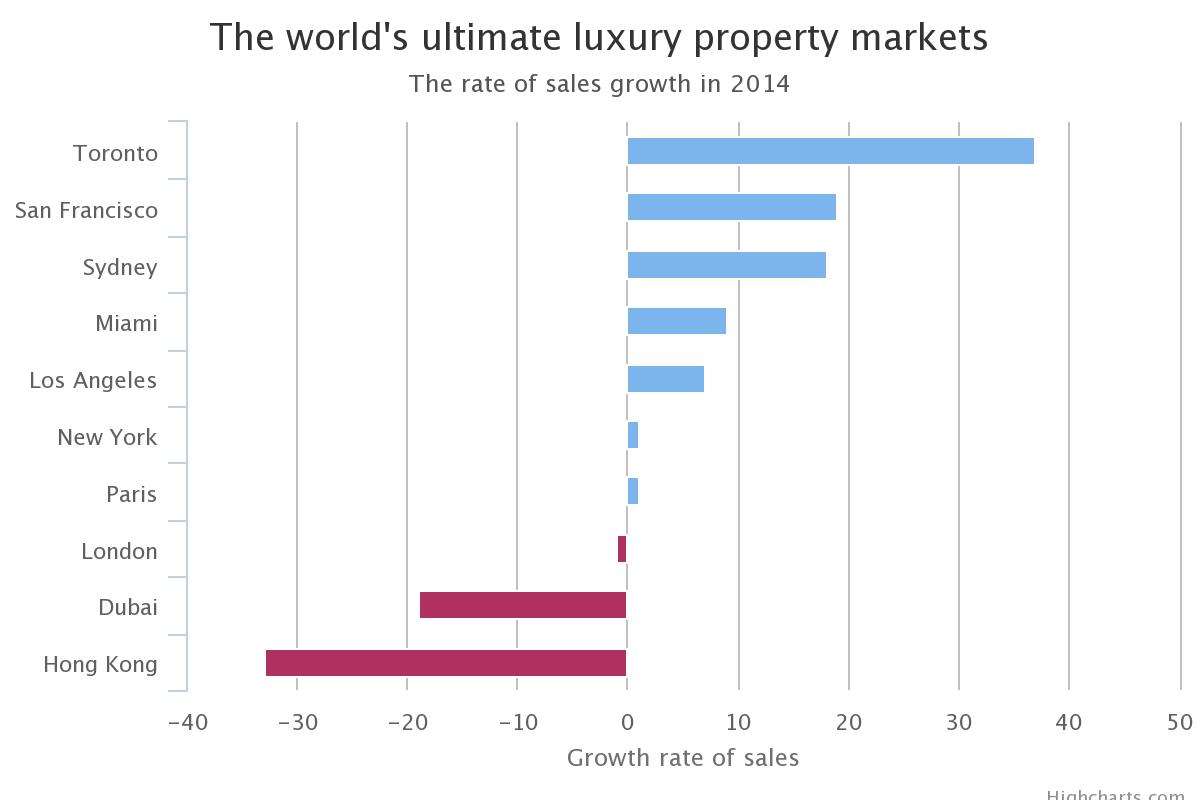
Toronto is towering above the rest of the world’s luxury property markets, as the only city to record an acceleration in the sales rate of high-end homes from 2013 to 2014.

The Canadian city, well known for its economic stability, experienced a 37pc increase in the sale of luxury penthouses, apartments and houses in the 12 months to the end of December, after just a 4pc rise in the previous year, outstripping San Francisco, Sydney and Miami, according to a report from Christie’s international real estate group.

The study, which ranks the top 10 urban centres by the growth in sales of exclusive properties, found that the rate also slowed in Los Angeles, New York and Paris, while transactions declined in London, Dubai and Hong Kong last year.

Cost of Police Riot Gear

image

American law enforcement face a daunting task of regaining control of neighborhoods in cities once a riot breaks out. Police for decades have been educated and trained for these types of situations. Technology has developed to help the officers but it comes with a cost.

Friend of mine who is in law enforcement and has years of experience training for these scenarios gave out some information in the cost of some of the riot gear police use. Here is the breakdown of a few of the devices used by law enforcement:

One Hand Deployed Distraction Device, AKA “Flash Bang” – $50.00

One Flameless Chemical Tri Chamber, AKA “CS/CN Canister” – $50.00

One 12 Gauge Drag Stabilized Bean Bag Lethal Impact Round – $8.00

Oil Stocks Outperform in State Pension Funds

WorldOil.com is showing interesting investment returns on state pension funds invested in oil. The study was done by Sonecon.

On average, $1 invested in oil and natural gas stocks in 2005 was worth $2.30 in 2013. By contrast, $1 invested in all other assets over the same period was worth $1.68.

While oil and natural gas stocks make up, on average, 4% of holdings in the top public pension funds, they accounted for, on average, 8% of the returns in these funds from 2005 to 2013, according to the Sonecon study.                                    

The report examines the top two public pension funds in 17 states, which collectively cover more than half (55%) of all workers in the U.S. who participate in state and local government pension plans.

States analyzed in the report are: California, Florida, Illinois, Indiana, Iowa, Michigan, Minnesota, Missouri, Nebraska, New Hampshire, New Mexico, New York, North Dakota, Ohio, Pennsylvania, South Carolina, and West Virginia.


Update on Cell Phones in Indiana Prisons

Back in February I posted about the unspoken economy of cell phones in U.S. prisons. These cell phones obtained by prisoners pose a serious public safety risk as they have been used by gangs to carry out hits on gang rivals outside the prison or to relay messages to other prisoners to cause violence in other prisons.

I recently contacted the Indiana Department of Corrections for an update of how many cell phones prison guards have confiscated in 2015. I want to thank INDOC spokesperson Isaac Randolph for the information.
image

Hybrid Car Owners Breaking Up With Mother Earth

escalade

Hybrid car owners are not feeling the love of the environment anymore and showing it with their purchasing power. I remember the hysteria a decade ago if you didn’t buy a hybrid then you didn’t love Mother Earth. JustFactsDaily.com had this question up on their website for viewers to answer:

    Thus far in 2015, what portion of the people who traded in a hybrid or electric car purchased another such car?

Once you answered, they provided documentation to research done by Edmunds.com:

    Car buyers are trading in hybrid and electric cars for SUVs at a higher rate than ever before, according to a new analysis from car-buying platform Edmunds.com.

    According to Edmunds.com, about 22 percent of people who have traded in their hybrids and EVs in 2015 bought a new SUV. The number represents a sharp increase from 18.8 percent last year, and it is nearly double the rate of 11.9 percent just three years ago. Overall, only 45 percent of this year’s hybrid and EV trade-ins have gone toward the purchase of another alternative fuel vehicle, down from just over 60 percent in 2012. Never before have loyalty rates for alt-fuel vehicles fallen below 50 percent.

Edmunds also provides analysis of how long it takes financially to justify paying the price of hybrid vehicles with gas price savings:

    To underscore the point, Edmunds calculates that at the peak average national gas price of $4.67/gallon in October 2012, it would take five years to break even on the $3,770 price difference between a Toyota Camry LE Hybrid ($28,230) and a Toyota Camry LE ($24,460). At today’s national average gas price of $2.27/gallon, it would take twice as much time (10.5 years) to close the same gap.

Is California Dead?

Joel Kotkin is the RC Hobbs Fellow in Urban Futures at Chapman University in Orange, California. He recently just published an article at the The Dialy Beast titled, “The Big Idea: California Is So Over”. It is well worth the read from a person who has lived in California and studied the politics/culture for multiple decades. Here is one snippet-

    But ultimately the responsibility for California’s future lies with our political leadership, who need to develop the kind of typically bold approaches past generations have embraced. One step would be building new storage capacity, which Governor Jerry Brown, after opposing it for years, has begun to admit is necessary. Desalinization, widely used in the even more arid Middle East, notably Israel, has been blocked by environmental interests but could tap a virtually unlimited supply of the wet stuff, and lies close to the state’s most densely populated areas. Essentially the state could build enough desalinization facilities, and the energy plants to run them, for less money than Brown wants to spend on his high-speed choo-choo to nowhere. This piece of infrastructure is so irrelevant to the state’s needs that even many progressives, such as Mother Jones’ Kevin Drum, consider it a “ridiculous” waste of money.

You can read the entire article here.