Farm Bill & Indiana Schools Facing Obamacare “Uncertainty”

Image


Indiana Senator Joe Donnelly was recently on the floor of the Senate pleading for the passage of the new ten year farm bill currently up for debate. He did the basic verbal judo political speak in saying the bill would help “Hoosier Farmers”. Senator Donnelly is very much celebrated as a moderate thinker by the political writers at the Indianapolis Star. I personally have challenged a few of their writers in what direction he would choose once in the Senate and get the usual “Bipartisanship” line and that is about it. I am not seeing anything as of right now from the Indianapolis Star on this issue but if they write about his statements on the proposed farm bill, it will be very nuanced without much substance.

The current Farm Bill of 2013 will most likely pass the Senate and head to the House. The farm bill is anything but a farm bill. Here is small paragraph from RedState.com

Today, the Senate will invoke cloture on the 5-year farm bill, S. 954.  The 1150-page Senate bill costs $955 billion over 10 years and creates a new shallow loss program covering up to 90% of a farmer’s income – on the taxpayer dime.  Roughly 80% of the cost is related to food stamps.  For good measure, this bill contains sugar subsidies, biofuels subsidies, and conservation programs.  This mega-bill was rushed through the committee process and has only been subject to four amendments on the floor. 

Farm bills of this magnitude need to be stopped and absolutely broken down for separate votes. On top of that, when a Senator like Joe Donnelly steps to the microphone to express support for this bill, just be honest and say what the bill is.  Here is the link to his floor speech and it says nothing about what the bill really is intended to support.

One more piece to “Farm Bills”, they hardly ever help a bunch of farmers. Face the Facts USA has an excellent breakdown of the most previous data of the last farm bill. They added a nice slideshow for their data breakdown. Here is the link for their article but will post one small piece:

The most recent Farm Bill shows the bulk of its $96.2 billion cost went elsewhere. $77.6 billion in 2011 went to the food stamp program known as SNAP (Supplemental Nutrition Assistance Program). Just $13.44 billion went to programs for farmers.

Switching topics, more and more financial decisions are not only being made by businesses in how to adopt the coming Obamacare guidelines but local municipalities are as well. The new unspoken effects are hitting public schools. Just recently, my high school I attended released a statement saying part of the cuts they needed to make was from uncertainty with costs pertaining to the healthcare law. Now more news is coming out from other Indiana schools with what they have to do to be able to afford the law. This comes from Hancock County, Indiana:

Part-time employees could see their hours cut or changed under new federal regulations related to the Affordable Care Act. Though portions of the Affordable Care Act have been phasing in since its adoption in 2010, the new legislation grows teeth Jan. 1 and Hancock County governments, businesses and school districts are taking notice. Large employers who have part-time staff working between 30 and 40 hours a week, for example, will be required to provide health insurance. Failure to provide the coverage for 95 percent of the employer’s workforce could result in significant monetary penalties from the federal government.


Even the lawyers hired to help sort out the coming law are uncertain:

And while the law was designed to provide more Americans with affordable health care, there’s plenty of uncertainty surrounding the new regulations. “There’s mass uncertainty,” said Jim Matthews, attorney with Bose McKinney and Evans in Indianapolis who has been advising clients on the act. “There are so many surprises in this law, and they just keep coming and coming.”

The Eastern Hancock School Board had to cut non-contract employee hours from 30-40 to 29 hours. Not only is it the school district but the county itself:

The Hancock County Commissioners budgeted for a 20 percent increase in health insurance costs for 2014, still not knowing the full impact of the Affordable Care Act. Details of the 2014 budget will be worked out in the next few months, and one discussion point will be whether to cut the hours of some part-time employees or make them full-time. 

“Normally, you would benefit from two part-time positions rather than a full-time position,” Commissioner Brad Armstrong said. “But if your part-time position is going to get over 30 hours, then it incurs the cost in benefits, there’s really no savings in doing that.”

Many of the county’s part-time employees are in the community corrections department, said Mary Bowmer, payroll administrator. Adding health insurance for a single employee will come at a cost of more than $6,600 for the county.

The full article is in this link. This is just a microcosm of what is too come for the entire nation. Municipalities are struggling massively from tight budgets, this will only confuse the budget makers a few more years as this law plays out.
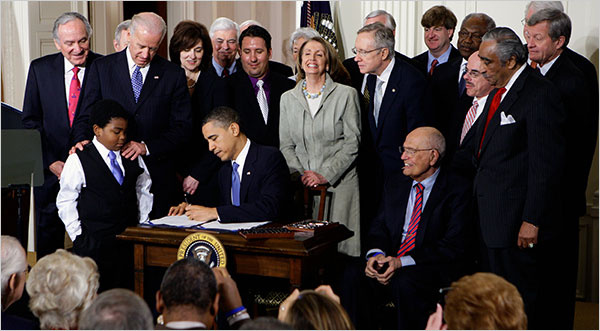


Early Indicator of “Obamacare”

obama healthcare

When Congress passed another healthcare plan designed to “help” the American people it had widespread implications. The bill has thousands of pages of not just law, but also regulations written after the bill was passed.

One of the programs within the bill for the HHS(Health & Human Services) agency to begin implementing right away was a “High Risk Pool” for people with already pre-existing conditions. I have been following this program for awhile now in the press. Here is the short version of what the program was created to do. Five Billion dollars was set aside to assist people with already pre-existing conditions until the full bill was implemented. Projections were to sign up anywhere from 350,000-500,000 people. Now the stats are out and should give many pause in seeing how costs of the total health care program will affect the United States government overall spending of this bill down the road.

Investors.com reported on April 10,2013:

ObamaCare funded the PCIP with $5 billion to cover patients with pre-existing conditions from 2010 to 2014. Less than a third of the people HHS projected would enroll in the plan actually signed up for the coverage. Yet despite the low enrollment, the plan is broke. In fact, it started running out of money at the beginning of this year, which means it busted its budget a full year ahead of projections. In a 2012 report, HHS conceded that it had miscalculated (though not until page 11 of its 15-page report): “On average, the PCIP program has experienced claims costs 2.5 times higher than anticipated.”

So what were the estimated numbers in 2010 for this one small program within the bigger healthcare plan? Here is a breakdown from the Heritage Foundation:

In 2010, the Obama Administration estimated that 375,000 people would enroll in the PCIP. But as of January 2013, over two-and-a-half years since the plan began, only 107,139 were enrolled—less than 29 percent of original projections.

Not only did costs skyrocket, but major changes to the program recipients as well:

In addition to suspending enrollment, CMS made major benefit adjustments in an effort to control program costs—mainly by increasing enrollee cost-sharing requirements. These changes included the consolidation of three plan options into one, increased co-insurance, and increased maximums for out-of-pocket costs (a 56 percent increase for in-network services and a 42 percent increase for out-of-network services).

This is not unexpected. History is filled with facts to teach us present day Americans about the fallacy of “Government Healthcare Programs” but we always choose the divine providence of “The Government” when it comes to social experiments. In the same article quoted above, they also had this historical data to show us the coming cost explosion from previous healthcare experiments:

In 1965, the Johnson administration figured Medicare would cost $12 billion by 1990. Its actual cost was $110 billion. Now it’s almost $600 billion and climbing.

Washingtontimes.com had these historical numbers on November 18,2009:

In 1965, the House Ways and Means Committee estimated that the hospital insurance program of Medicare – the federal health care program for the elderly and disabled – would cost $9 billion by 1990. The actual cost that year was $67 billion. In 1967, the House Ways and Means Committee said the entire Medicare program would cost $12 billion in 1990. The actual cost in 1990 was $98 billion.

Once 2014 kicks in which is full implementation of the law itself, we unfortunately will be on the side of waiting to see costs explode. Not only that aspect, but HHS will probably start changing rules once people have signed contracts for health insurance. Constantly changing rules is part of having “Centrally Planned” programs by the government.

Like I said, we unfortunately will have to wait and see.

Government Sells Debt This Week….Here’s How It Went

Image

The United States Treasury sold quite a bit of debt this week and here is the round up of how it went. Quick note: 10 Year Treasuries have been spiking lately suggesting that investors are now demanding the government pay more on their interest on debt. July 2012 it was 1.38%. It now stands at 2.17%. 

– On Thursday, $29 Billion was sold in 7 year notes at a yield of 1.496%. This is the highest since March 2012. Almost 40% of the debt was bought up by indirect bidders which include foreign central banks. Another 20% was bought up by direct bidders which is money managers. 

– On Wednesday, the Treasury sold $35 Billion in five year notes. Indirect/Direct buyers accounted for 67% of the purchases because interest rate was higher. Bidders got 1.045% which is the highest since October 2011.

-On Tuesday, the government ran into some problems with their 2 year notes. They sold a total of $35 Billion in debt to mostly primary dealers. Indirect/Direct only accounted for 33% of the buying. This was the fewest bids for two year notes since February 2011.

Overall the government sold $99 Billion in debt. Obviously this has to be paid back in 2-7 years with either more tax revenue(which means tax increases) and/or new bond sales. Interest rates appear to be going up by investors wanting more comfort since government has so much debt and with other investments paying higher percentage of return. The government has to play just like everyone else seeking investors to buy their debt.

May “Interest on Debt” payments have not been released yet. But so far in the fiscal year 2013 (which began in October 2012), United States Treasury has paid around $228 Billion on interest on debt. You can track the interest on debt yourself at this site